

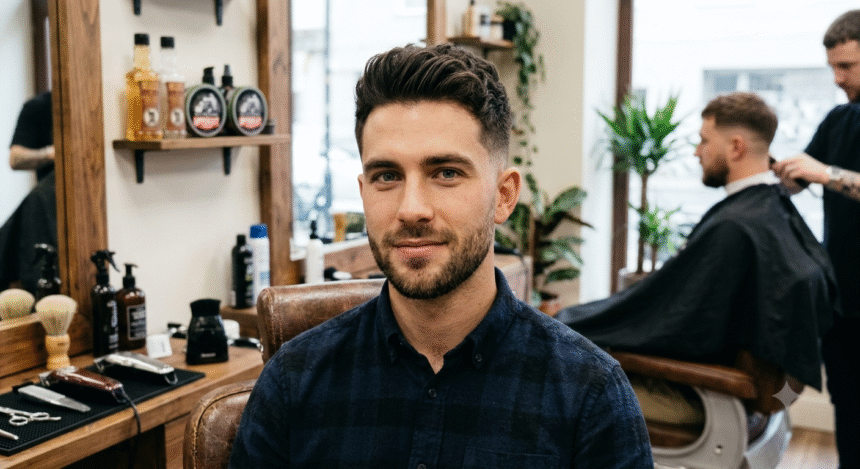
An oval face is the most forgiving shape for men’s hair. The goal is not to fix anything, it is to avoid tipping the balance. Keep the top no more than about twice the length of the sides, show some forehead, and choose texture that suits your hair type. Textured crops, classic side parts, soft quiffs, and medium layers are the safest and sharpest picks.
Most men with an oval face hear the same line from friends: “You can pull off anything.” It is mostly true, and it is also the reason so many oval-faced guys sit down in the barber’s chair without a plan and walk out with a cut that fights their proportions. A towering pompadour stretches the face. A heavy fringe hides the forehead. A shapeless mop makes everything look the same width.
This guide gives you a plan. You will learn how to confirm your face shape at home, the one balancing rule that matters, 15 haircuts that work (with hair-type notes and upkeep timelines), what to avoid, how beards and glasses change the picture, and a simple script to hand your barber. It is written for real mornings, the kind where you have ten minutes, a coffee, and possibly a toddler asking for breakfast.
What Is an Oval Face Shape?
An oval face is longer than it is wide, with the widest point across the cheekbones. The forehead is slightly narrower than the cheekbones, and the jaw curves softly into a rounded chin instead of ending in corners. Think of an egg standing upright: fuller through the middle, gently tapering at the top and bottom.
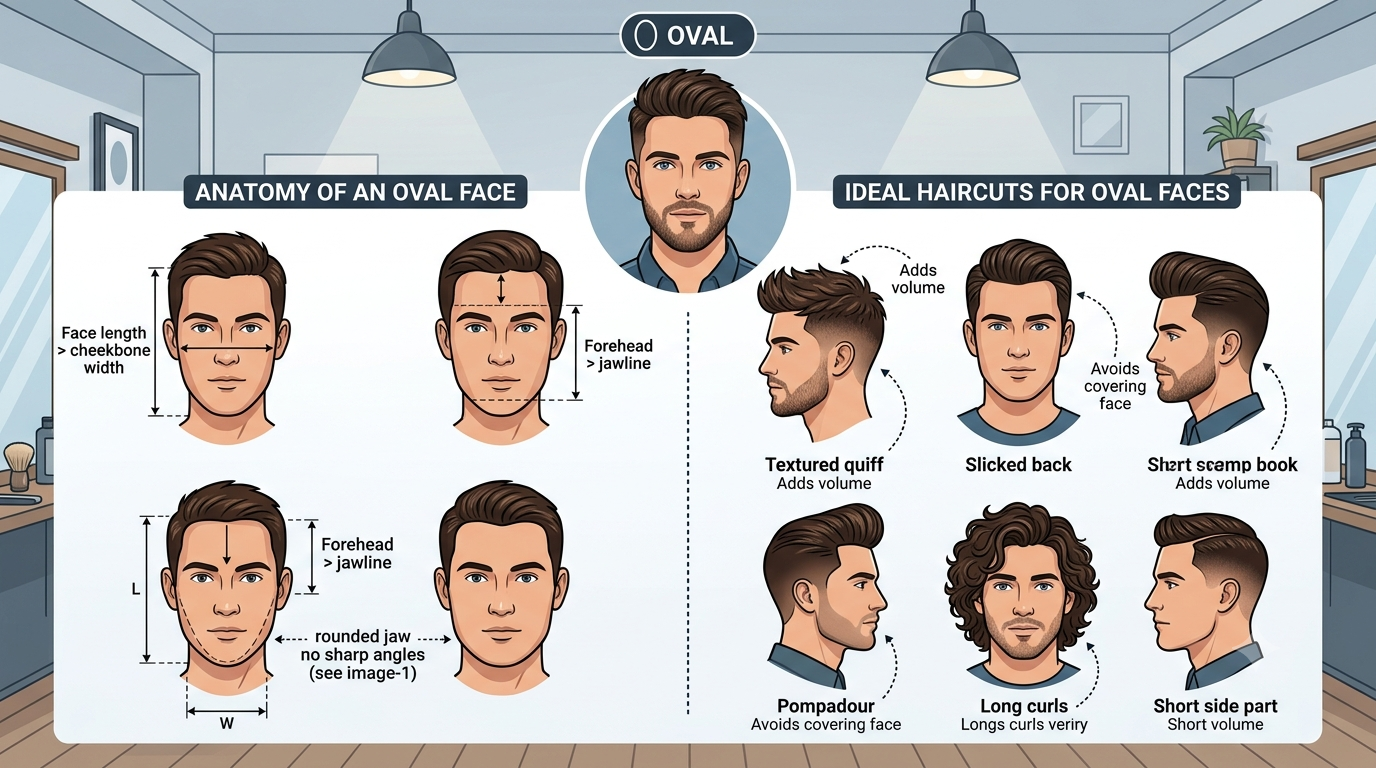
Barbers like oval faces for one reason. The proportions are already balanced, so a good cut mostly has to avoid exaggerating length or width.
How to Check Your Face Shape at Home
You only need a mirror, a soft tape measure (or a piece of string and a ruler), and about two minutes. Pull your hair back so nothing hides your outline.
- Length: measure from the middle of your hairline to the tip of your chin.
- Cheekbone width: measure across the widest part of your cheekbones.
- Forehead width: measure across the forehead at the midpoint of each eyebrow.
- Jaw width: measure from the corner of your jaw to the corner on the other side.
- Compare: if your length is roughly one and a half times your cheekbone width, your cheekbones are the widest measurement, and your jaw looks rounded rather than angular, you have an oval face.
| Feature | Oval | Oblong | Round | Square |
|---|---|---|---|---|
| Length vs. width | About 1.5 to 1 | 1.7 to 1 or more | Nearly equal | Nearly equal |
| Widest point | Cheekbones | Fairly even | Cheeks | Jaw, forehead, cheeks similar |
| Jaw | Soft, curved | Long, straight sides | Soft, full | Angular, strong |
| Styling goal | Keep balance | Reduce visual length | Add height and angles | Soften or embrace edges |
The most common mix-up is oval versus oblong. If your face looks long with straight, parallel sides, you are probably oblong and should avoid adding height. If the sides curve gently, you are oval. When in doubt, take photos facing the camera straight on, in even light, with your hair pulled back, and compare them with the table above.
The One Rule That Makes Every Haircut Work: The 2-to-1 Ratio
If you remember a single thing from this article, make it this: keep the length on top at no more than roughly twice the length on the sides. If the sides are 1 inch, aim for about 2 inches on top, with a ceiling of around 4 inches for longer, softer styles.
Why it works: an oval face is already slightly longer than it is wide. Extra height on top adds more length. Sides that are cut too tight make the head look narrower, which makes the face look even longer. Staying near that 2-to-1 range keeps the shape in its natural proportion.
Three supporting rules:
- Show some forehead. The gentle taper of an oval forehead is a feature. Fringes should frame it, not cover it.
- Avoid piling volume at cheekbone level. That is already the widest point.
- Let texture do the work. On an oval face, movement looks better than hard, flat lines.
15 Best Haircuts for Men With an Oval Face
Each style below includes who it suits, how to ask for it, and how often you will need a trim. Timelines assume average hair growth, and the first sign a cut is overdue is usually fading sides or a top that no longer holds its shape.
1. Textured Crop
Best for: straight to wavy hair, busy people who want a cut that looks styled with almost no effort.
A short, choppy top with a low or mid fade or taper. The broken-up texture adds interest without adding height, which keeps the ratio intact.
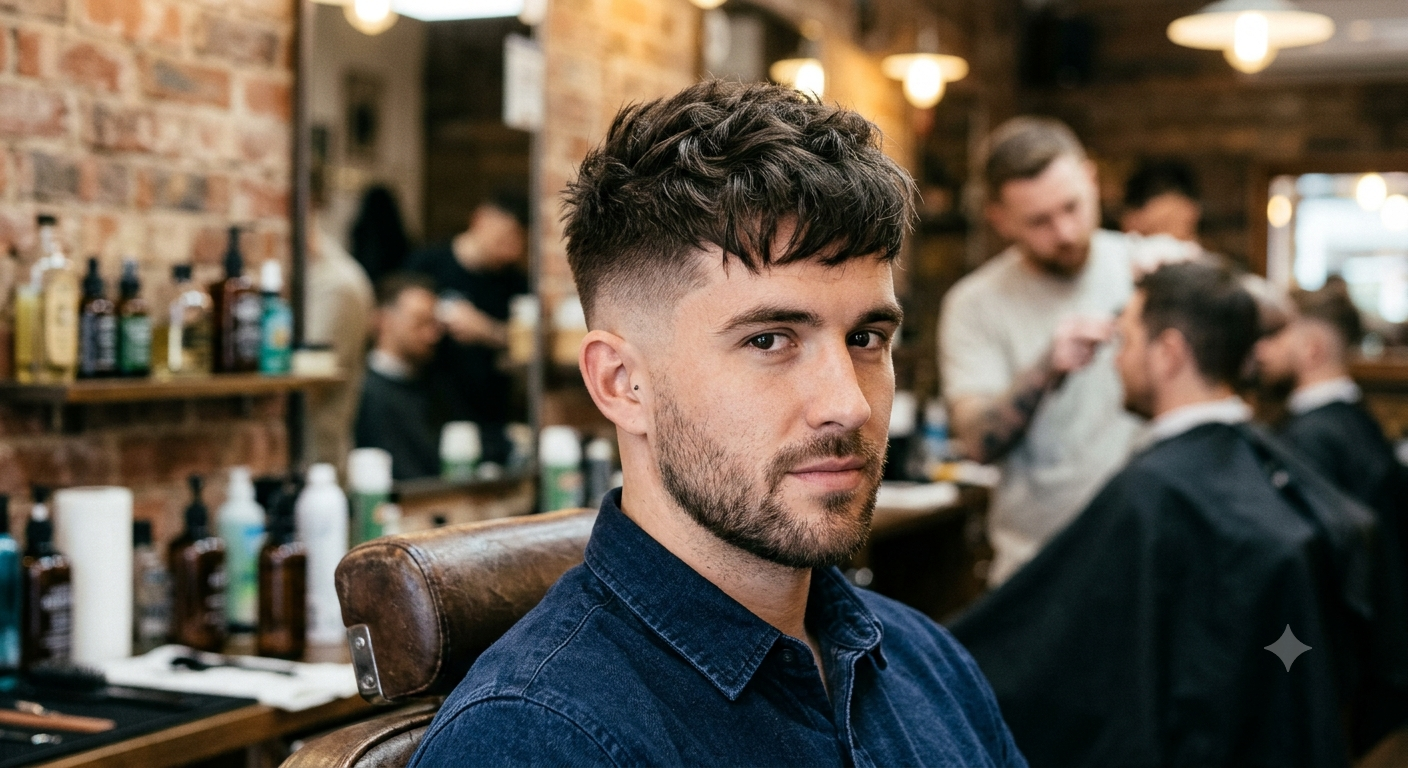
Ask your barber for: a textured crop with point cutting on top, 1.5 to 2.5 inches of length, and a low to mid taper. Style it: a pea-sized amount of matte clay worked through dry hair with your fingertips. Upkeep: every 3 to 4 weeks.
2. Classic Side Part
Best for: straight or slightly wavy hair, office settings, anyone who wants a timeless look.
A defined part about an inch or so from the center line, with hair combed to the side. The diagonal line adds structure without adding height, which is why it flatters balanced faces so reliably.
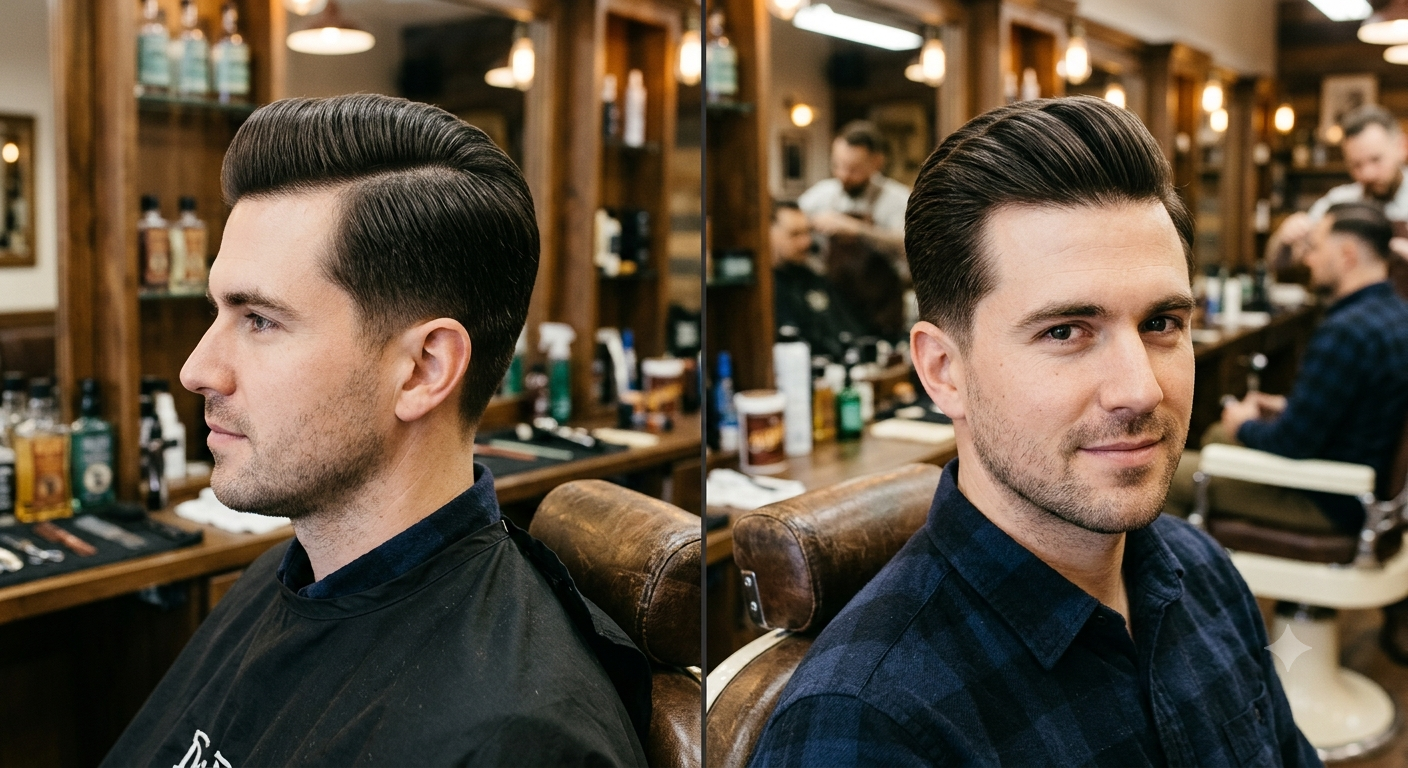
Ask your barber for: a classic side part with scissor-cut top, about 3 inches long, and a tapered neckline. Style it: light pomade or cream on damp hair, then comb along the natural part. Upkeep: every 4 weeks.
3. Modern Quiff
Best for: medium to thick hair that holds volume.
A softer, shorter cousin of the pompadour. Hair is lifted and swept slightly back and up at the front. Keep the lift modest and it adds personality without stretching the face.
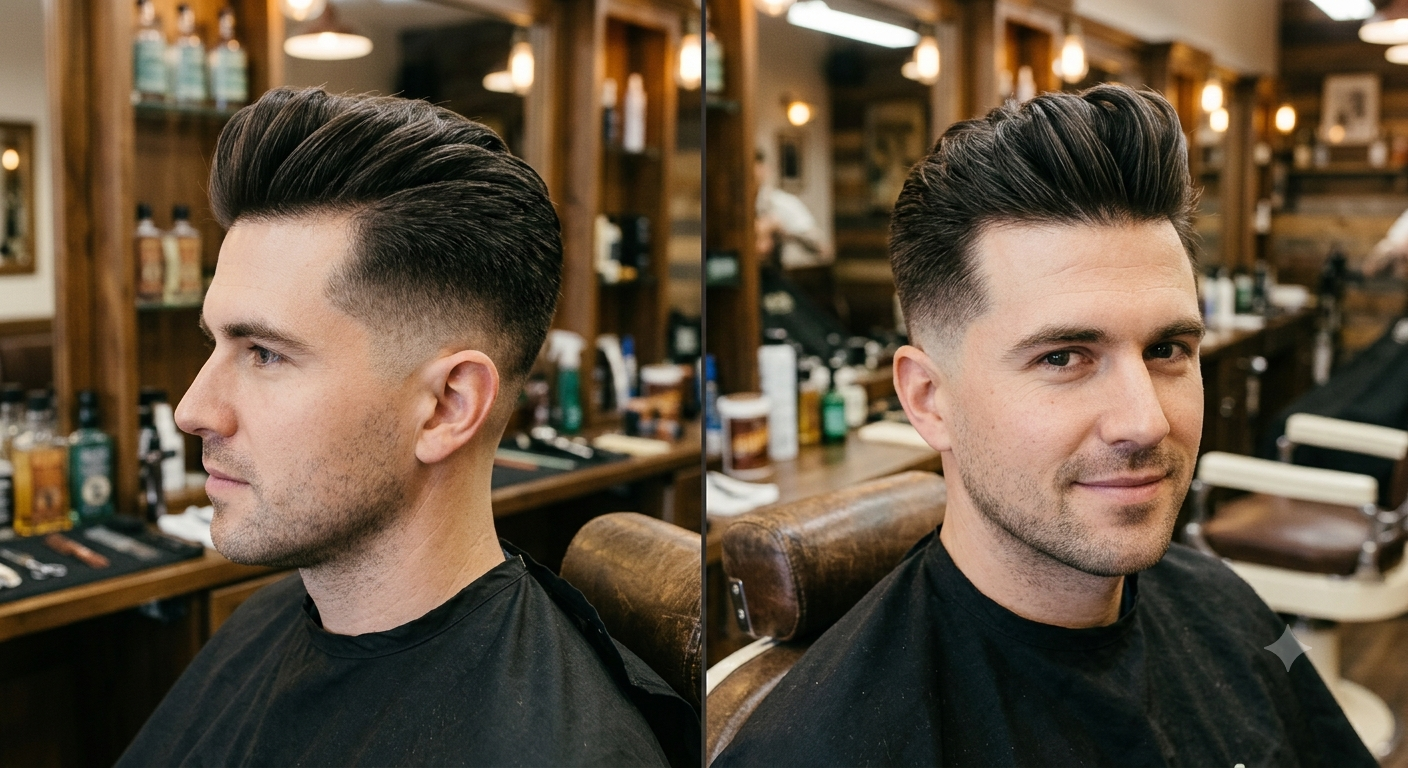
Ask your barber for: a quiff with 3 inches of top length at most and a mid taper or mid fade. Style it: blow-dry upward from the roots, then finish with matte clay or paste. Upkeep: every 3 to 4 weeks.
4. Ivy League (Princeton)
Best for: straight hair, professional environments, anyone who wants something clean but not boring.
A slightly longer version of the crew cut with enough length on top to part or sweep to the side. It sits comfortably within the 2-to-1 rule and grows out gracefully.
Ask your barber for: an Ivy League cut with a scissor-tapered back and sides and a natural side part. Style it: a little pomade, then comb. No blow-dryer required. Upkeep: every 4 to 5 weeks.
5. Crew Cut
Best for: nearly all hair types, low-maintenance routines.
Short and uniform, with a bit more length at the front. A crew cut leaves your bone structure on display and demands very little from you.
Ask your barber for: a crew cut with about 1.5 to 2 inches on top and a low taper. Style it: towel dry and, if you like, push the front slightly forward with a dab of paste. Upkeep: every 3 weeks.
6. Buzz Cut
Best for: men who want zero styling time and have a well-shaped head.
Oval faces are one of the better matches for a buzz cut because the proportions already look balanced. Choose a guard length that suits your head shape, and ask for a clean line at the forehead and neck. Check your head shape first, because buzz cuts reveal bumps and flat spots.
Ask your barber for: a number 2 or 3 guard on top, slightly shorter at the sides if you like a taper. Upkeep: every 1 to 2 weeks to keep the edges tidy.
7. Skin Fade With a Textured Top
Best for: straight, wavy, or loosely curly hair, anyone who likes a sharp, modern outline.
The fade goes down to skin at the sides while the top keeps 2 to 3 inches of texture. The contrast sharpens your cheekbones and jaw. Just make sure the top has enough length to keep balance, since a very tight fade with a flat top can narrow the head.
Ask your barber for: a low or mid skin fade with a textured top of 2 to 3 inches. Style it: matte paste on damp hair, finished with a blow-dry and your fingers. Upkeep: every 2 to 3 weeks.
8. Caesar Cut
Best for: thick or straight hair, receding temples that you want to soften.
A short, even length with a light horizontal fringe. The modern version keeps the fringe textured and slightly broken up so it frames the forehead rather than shutting it off.
Ask your barber for: a Caesar with a textured, not blunt, fringe and a low fade. Style it: a bit of cream pushed forward. Upkeep: every 3 to 4 weeks.
9. Controlled Pompadour
Best for: thick hair and men who want a statement.
The pompadour works on an oval face as long as it stays moderate. At around 3 inches of lift it looks sharp. At 5 to 6 inches it elongates the face. The secret is lifting from the roots rather than piling height at the front.
Ask your barber for: a short, controlled pompadour with a low taper. Style it: blow-dry up and back, then use a matte wax rather than a high-shine pomade. Upkeep: every 3 weeks.
10. Curtain Hair
Best for: straight to wavy hair with some natural flow.
A center or slightly off-center part with hair falling gently to each side. The symmetry flatters the curved shape of an oval face. It is also a strong choice if you are growing out a shorter cut.
Ask your barber for: medium-length curtains with light layering and no blunt ends. Style it: a light sea salt spray and air dry. Upkeep: every 6 to 8 weeks.
11. Medium Layers
Best for: wavy or thick hair.
Three to four inches of length with layers that add movement across the sides, not just at the crown. Starting the layers at or just below cheekbone level helps avoid extra width at the widest point.
Ask your barber for: layered medium length with a softly tapered neckline. Style it: a light cream, then let it dry naturally. Upkeep: every 6 weeks.
12. Textured Undercut
Best for: thick, wavy hair.
Shorter sides with a fuller top. Keep the transition soft rather than shaving the sides to the skin, and style the top sideways or slightly back instead of straight up.
Ask your barber for: a soft undercut with a blended transition and 3 inches on top. Style it: clay for separation. Upkeep: every 3 weeks.
13. Slick Back With a Taper
Best for: medium to thick hair.
Hair is combed straight back, with sides tapered rather than faded to skin. The taper keeps some side volume, which helps preserve balance. It is a neat, polished option for events and work.
Ask your barber for: a slick back with 3.5 to 4 inches on top and a classic taper. Style it: a medium-shine pomade on damp hair, then comb back. Upkeep: every 4 weeks.
14. Natural Flow (Bro Flow)
Best for: wavy hair, men who prefer to wash and go.
Medium to long hair left to move naturally, with only a light shape-up. There are no hard lines to maintain, which makes it forgiving when you skip a trim.
Ask your barber for: a light trim to remove split ends, a gentle taper, and long layers. Style it: sea salt spray and air dry. Upkeep: every 8 to 10 weeks.
15. Curly Hair, Short and Tapered
Best for: curly and coily hair types.
Natural curls add volume in every direction. A low to mid taper keeps the sides full enough to protect balance, while curls on top give the cut its character. If you wear a short afro, keep the sides slightly shorter than the top so the shape stays slightly longer than wide.
Ask your barber for: a low to mid taper, with curls left at 2 to 4 inches on top and edges kept clean. Style it: a leave-in conditioner and a curl cream, with no heavy gel. Upkeep: every 3 to 5 weeks.
Match the Cut to Your Hair Type
On an oval face, your hair type usually narrows your choices more than your face shape does. Use this as a shortcut.
| Hair type | Strongest picks | Watch out for |
|---|---|---|
| Straight | Side part, Ivy League, Caesar, textured crop | Looking flat. Ask for point cutting for texture. |
| Wavy | Curtain hair, medium layers, natural flow, quiff | Over-straightening, which removes your natural movement. |
| Curly or coily | Tapered curls, short afro, textured top with fade | Heavy gels that weigh curls down. |
| Fine or thinning | Short crop, textured crop, buzz cut | Long, flat styles that expose thin patches. |
| Thick | Pompadour, undercut, faux hawk, quiff | Bulk at the sides. Ask for thinning or tapering. |
Haircuts to Avoid (or Adjust) With an Oval Face
Oval faces are flexible, but a few choices consistently work against them.
- A very tall pompadour or quiff. Past about 4 inches of lift, the face begins to read as longer than it is.
- Heavy, blunt bangs. They cover the forehead and can make the face look rounder or shorter.
- Mop-style cuts with no shape. Uniform length with no structure hides your proportions instead of showing them.
- Extra volume at the cheekbones. Wide, puffy sides add width where you already have it.
- Ultra-tight sides with a flat, short top. This narrows the head and makes the face look longer.
- Overly long, flat hair that hangs straight down. It can drag the face’s features downward and make it look longer.
The good news is that most of these are adjustments, not bans. A fringe is fine if it is textured and light. A pompadour is fine if it stays moderate.
Beards, Glasses and Your Haircut
Beards. You do not need a beard to balance an oval face, which makes it a style choice rather than a correction. A short boxed beard or a neatly trimmed full beard suits most oval faces. Avoid shaping the beard so it widens the lower cheeks, and avoid a long, pointed chin beard, which adds length.
Glasses. Oval faces suit most frames. Slightly angular or geometric frames add definition, while very narrow frames can emphasize length. If you wear glasses daily, choose a haircut that does not collide with the frames at the temples: a high-volume top with thick frames can feel heavy, and a clean taper around the ears keeps things neat.
How to Talk to Your Barber (Simple Script)
Photos help, but vocabulary helps more. Try this:
“I have an oval face, so I want to keep my proportions balanced. I would like about [X] inches on top and a [low/mid] taper on the sides. Please keep some texture on top and leave a bit of the forehead showing. I have [straight/wavy/curly] hair and about [X] minutes to style it each morning.”
Then add the one detail most men forget: tell your barber how long you usually go between cuts. A cut designed for a three-week schedule grows out very differently than one designed for eight.
Low-Maintenance Tips for Busy Parents
If your mornings revolve around lunchboxes, school runs, and the occasional meltdown (see our guide to handling toddler tantrums), a hair routine needs to be fast. A few habits make a big difference:
- Choose a cut that works with your natural texture. It halves your styling time.
- Pick one product and learn it well. A matte clay or paste handles most oval-friendly styles.
- Style on damp hair. It is faster and gives better hold than styling bone-dry hair.
- Book your next appointment before you leave. It is the easiest way to avoid growing out of shape.
- Keep a travel-size product in the car or bag for quick fixes before school events.
Grooming is also a small piece of looking after yourself. If you are building healthier routines for the whole household, our calm, practical family health guide is a good place to start, and our Lifestyle section covers more everyday habits that keep busy families feeling put together. For the bigger picture of balancing family life and personal time, read the complete guide to real motherhood, every stage, and browse more Mom Life articles.
Maintenance Cheat Sheet
| Style | Typical length on top | Trim every | Daily effort |
|---|---|---|---|
| Buzz cut | Under 0.5 inch | 1 to 2 weeks | None |
| Crew cut | 1.5 to 2 inches | 3 weeks | Very low |
| Textured crop | 1.5 to 2.5 inches | 3 to 4 weeks | Low |
| Skin fade with textured top | 2 to 3 inches | 2 to 3 weeks | Low to medium |
| Side part / Ivy League | 2 to 3 inches | 4 weeks | Low |
| Quiff / pompadour | 3 to 4 inches | 3 weeks | Medium to high |
| Curtains / layers | 3 to 5 inches | 6 to 8 weeks | Low |
| Natural flow | 5 inches or more | 8 to 10 weeks | Very low |
Frequently Asked Questions
What is the best haircut for an oval face?
There is no single best cut, but a textured crop and a classic side part are the most reliable starting points. Both keep length in balance and work with a wide range of hair types.
Can men with an oval face wear a buzz cut?
Yes. Because oval proportions are already balanced, a buzz cut usually looks clean without a beard. Make sure the shape of your head suits it, since a buzz cut shows every contour.
Is a fringe bad for an oval face?
Not necessarily. A light, textured fringe that frames the forehead works well. A thick, blunt fringe that covers it is the version to avoid.
Do I need a beard if I have an oval face?
No. A beard is a style choice, not a correction. If you grow one, keep it neat and avoid adding extra width at the cheeks.
What fade is best for an oval face?
A low or mid fade is the safest option. A high fade can work but narrows the sides, so keep enough length on top to maintain the 2-to-1 ratio.
How do I tell the difference between oval and oblong?
Compare length to width. Oval faces are about 1.5 times longer than wide with softly curved sides. Oblong faces are longer, roughly 1.7 times or more, with straighter sides. If you are oblong, avoid adding height on top.
Which products work best for oval faces?
Matte clay, paste, and sea salt spray suit most styles because they add texture without flattening. Heavy gel and very shiny pomade tend to make hair look flat and flatten out the movement that suits an oval face.
How often should I get my hair cut?
That depends on the style. Fades and short crops need attention every 2 to 4 weeks, while layered or longer styles can go 6 to 10 weeks. Use the cheat sheet above.
Final Thoughts
An oval face gives you freedom, and the smartest way to use it is with a few guardrails: keep the top around twice the length of the sides, show some forehead, and choose texture that matches your hair. Start with one of the safe, low-effort options such as a textured crop or a side part, then experiment from there.
If you found this guide useful, explore more everyday style and routine ideas in our Lifestyle category, learn who we are, or head back to the Famousparenting Momlife homepage.