

I remember sitting in my sister-in-law’s living room when her son was about ten months old, watching her wave at him from across the room and call his name three, four, five times before he even glanced up. She laughed it off — “he’s just in his own world today” — but I saw the flicker of worry cross her face. That moment stuck with me, because I think almost every parent has had a version of it: a quiet second where you wonder, is this normal, or is this something?
If you’re here because you’ve had that same flicker, take a breath. Noticing is not the same as diagnosing, and asking questions early is one of the most protective things you can do for your child. This isn’t a checklist meant to alarm you — it’s meant to help you understand what pediatricians and developmental specialists are actually watching for, so you can bring specific, useful observations to your next well-child visit.
Autism Doesn’t Look the Same in Every Baby
Before getting into specific signs, it helps to know that autism spectrum disorder shows up differently from child to child. Some babies show noticeable differences within their first year of life. Others develop typically through their first birthday or two, then plateau or even lose skills they’d already picked up — a pattern doctors call regression. There isn’t one single “autism baby” profile, which is exactly why pediatric organizations recommend routine screening for every child rather than waiting for parents to raise a red flag.
The American Academy of Pediatrics recommends developmental screening at 9, 18, and 30 months, with autism-specific screening at the 18- and 24-month visits. That timeline exists because the earlier a developmental difference is identified, the sooner a child can start therapies that work with their brain rather than against it — but it also means you, as the parent watching your baby every single day, are often the first to notice something before it ever shows up on a screening form.
Signs to Watch for by Around 6 Months
At this stage, doctors are mostly looking at how a baby engages socially rather than at speech or movement.
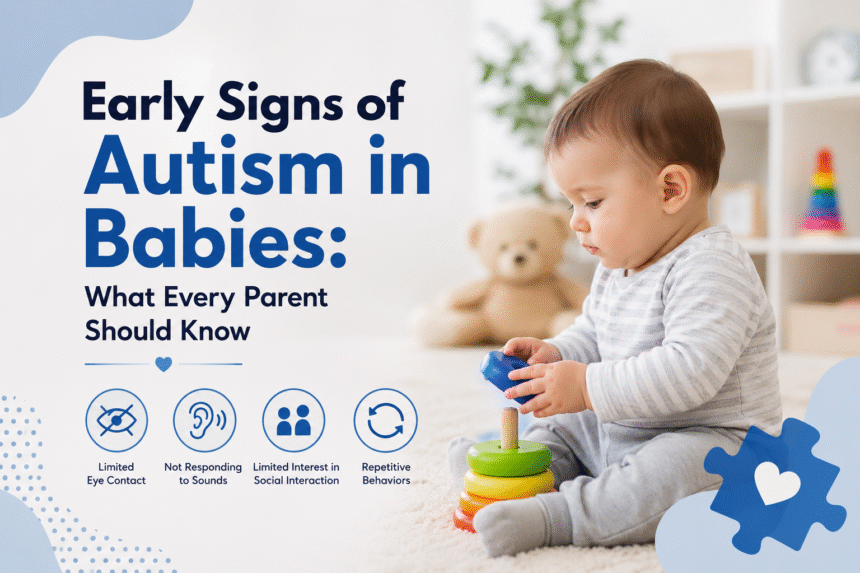
- Limited or absent social smiling — not lighting up when a caregiver smiles or talks to them
- Little interest in faces, or difficulty maintaining eye contact during feeding or play
- Seeming unusually passive or, on the other end, unusually difficult to soothe
Keep in mind that six-month-olds vary enormously in temperament. A baby who’s simply more serious or independent by nature isn’t automatically showing signs of anything. What matters more is a consistent pattern of missing social connection, not a single quiet afternoon.
Signs to Watch for Between 7 and 12 Months
This window is when a lot of the differences parents describe as “a gut feeling” start to become more concrete.
- Not responding to their name even after repeated, close-range calling
- Little or no babbling — no strings of sounds like “ba-ba” or “da-da” by around 9 months
- Limited gesturing — not waving bye-bye, not reaching to be picked up, not pointing at things they want
- Reduced sharing of attention, sometimes called joint attention — for example, not looking where you point, or not showing you a toy just to share the moment
- Delayed motor milestones, including crawling later than peers or appearing unsteady when trying to sit or pull up
- Unusual visual behavior, like intense fascination with spinning objects, moving parts, or watching things out of the corner of their eye
If you’re tracking motor development alongside this list, our guide on how babies learn to crawl walks through the typical crawling timeline stage by stage, which can help you tell the difference between a baby who’s simply taking their time and a pattern worth mentioning to your pediatrician.
Signs to Watch for Between 12 and 18 Months
By the first birthday, communication differences tend to become clearer.
- No single words by 16 months
- No meaningful two-word phrases by 24 months (a milestone worth flagging early if speech seems significantly behind)
- Not imitating simple actions, like clapping or waving, that they’ve seen modeled repeatedly
- Preferring to play alone consistently, even when others try to engage them
- Strong attachment to routines, with noticeable distress at small changes
- Repetitive movements such as hand-flapping, rocking, or lining up toys instead of using them functionally
One thing worth repeating: a single missed milestone rarely means much on its own. What clinicians pay attention to is a cluster of differences that persist over time, especially in the areas of social communication and repetitive behavior. If you’re comparing your child’s pace against general toddler milestones, our piece on what age counts as a toddler is a useful companion, since so many of these signs overlap with the same window when toddlerhood officially begins.
Regression: When a Baby Loses Skills They Already Had
One of the patterns that understandably worries parents most is regression — when a baby who was babbling, waving, or making eye contact seems to stop doing those things, usually somewhere between 15 and 24 months. This doesn’t happen to every child with autism, but when it does happen, it’s considered a significant sign worth bringing to a doctor right away rather than waiting for the next scheduled checkup.
What a Missed Milestone Doesn’t Mean
It bears repeating, because I know how easy it is to spiral into research at 1 a.m.: development is not a straight line. Premature birth, bilingual households, illness, and plain old individual temperament can all shift a baby’s timeline without any connection to autism at all. If you’re also tracking your due dates and adjusted age for a premature baby, the pregnancy due date guide on our site explains how adjusted age can change how milestones should be interpreted in those first two years.
The goal here isn’t to diagnose your baby from a blog post — no article can do that, and no responsible one should try. The goal is to help you notice patterns clearly enough that you can describe them accurately to a professional.
What to Do If You Notice These Signs
- Write it down. Keep a simple running note of specific behaviors and ages, rather than relying on memory during a rushed appointment.
- Bring it up at your next well-child visit — or sooner. You don’t need to wait for the 18-month screening if something feels urgent. Pediatricians would much rather address a concern early than late.
- Ask for a formal developmental screening, such as the M-CHAT-R, if your doctor hasn’t already offered one.
- Request a referral to early intervention services if a screening raises concerns. In many places, children can start receiving support services before a formal autism diagnosis is finalized.
- Trust your instincts, but don’t self-diagnose. Parents are remarkably accurate at noticing that “something is different,” even when they can’t name exactly what. Let a specialist take it from there.
If you’re newer to tracking your baby’s growth and milestones month to month, our baby age calculator can help you keep an accurate read on exactly how many weeks and months old your little one is, which makes it much easier to compare their development against age-specific guidelines instead of rough estimates.
Why Early Support Matters So Much
Research consistently shows that the first three years of life are a period of remarkable brain plasticity, which is exactly why early intervention tends to have such an outsized impact. Children who begin speech therapy, occupational therapy, or behavioral support early often build stronger foundational skills than those who start later, simply because the brain is more adaptable at that stage. Early identification isn’t about labeling a baby — it’s about opening the door to support while that door is widest open.
A Gentle Reminder
However this journey unfolds for your family, you are not failing by asking questions early, and you are not overreacting by paying close attention. Every parent in our community — including me — has spent a late night comparing their baby’s babbling to a video online. That instinct to notice, to double-check, to advocate, is exactly what your child needs from you, whatever the answer turns out to be. For more on navigating the emotional side of these early parenting years, our complete guide to real motherhood covers the stage-by-stage realities nobody quite prepares you for.
Frequently Asked Questions
Can autism be detected in a baby younger than 12 months?
Some signs, such as limited social smiling or reduced eye contact, can appear as early as 6 months, though most formal screenings begin closer to 18 months, and a reliable diagnosis is usually possible by age 2.
Does missing one milestone mean my baby has autism?
No. A single delayed milestone is common and often unrelated to autism. Doctors look for a consistent pattern across several areas of development, not one isolated behavior.
What should I do first if I’m concerned?
Talk to your pediatrician and ask for a developmental or autism-specific screening. You don’t have to wait for a scheduled milestone visit if something feels urgent.
Is early intervention available before an official diagnosis?
In many regions, yes. Early intervention programs can often begin once a screening raises concerns, even while a full diagnostic evaluation is still in progress.