

My cousin Emma still laughs about the day her son Kabir turned one. At the birthday party, her mother-in-law kept referring to him as “the baby,” while her sister-in-law, who works as a preschool teacher, kept correcting her: “He’s a toddler now, not a baby.” Emma, holding a very unbothered, cake-smeared Kabir, turned to me and asked the question so many new parents eventually ask: “Wait, so when exactly does a baby become a toddler? Is there an actual date this happens?”
It’s a more common question than you’d think, and the honest answer is both simple and a little more nuanced than a single number on a calendar. This guide walks through exactly what age counts as a toddler, why that range exists, what changes during this stage, and how to tell the difference between toddlerhood and the phases that come right before and after it.
So, What Age Is a Toddler?
According to the American Academy of Pediatrics, toddlerhood spans roughly ages 1 to 3 — that is, from a child’s first birthday until their third birthday. This is the widely accepted, standard definition used by pediatricians, child development researchers, and most parenting resources.

The word itself gives away the reasoning. “Toddler” comes from the verb “to toddle,” meaning to walk with short, unsteady steps — exactly how most one-year-olds move once they take their first wobbly steps. The name isn’t tied to a precise birthday so much as to a specific physical milestone: the shift from crawling, immobile infancy into upright, exploratory movement.
That said, definitions do vary slightly depending on the source. Some child development frameworks describe toddlerhood as beginning closer to 12 to 18 months (once independent walking is well established) rather than the instant a child turns one. A few resources even use a “28 months to 3 years” framing when they want to separate the wobbliest new walkers from the more confident, sturdier toddlers who are close to preschool age. In everyday use, though, almost everyone agrees on the same rough window: one year old to three years old.
Why Does the Exact Age Even Matter?
It’s fair to ask why parents should care about a label at all. A child doesn’t magically transform overnight just because a calendar flips to their first birthday. In truth, developmental stage names like “infant,” “toddler,” and “preschooler” aren’t strict biological categories — they’re organizing tools.
Pediatricians use them to group expected milestones together, so a wellness visit at 18 months looks for a different set of skills than one at 6 months or 4 years. Childcare centers use them to design age-appropriate classrooms, toys, and safety measures. Parents use them, informally, to know roughly what to expect next and to gauge whether their child’s growth looks typical.
The label is a guidepost, not a scorecard. A child who turns one but isn’t walking yet is still, developmentally, easing out of infancy — the calendar date and the developmental reality don’t always arrive on exactly the same day, and that’s completely normal.
The Toddler Years, Stage by Stage
Because so much changes between a first and third birthday, it helps to break “toddlerhood” down into smaller chunks rather than treating it as one uniform phase.
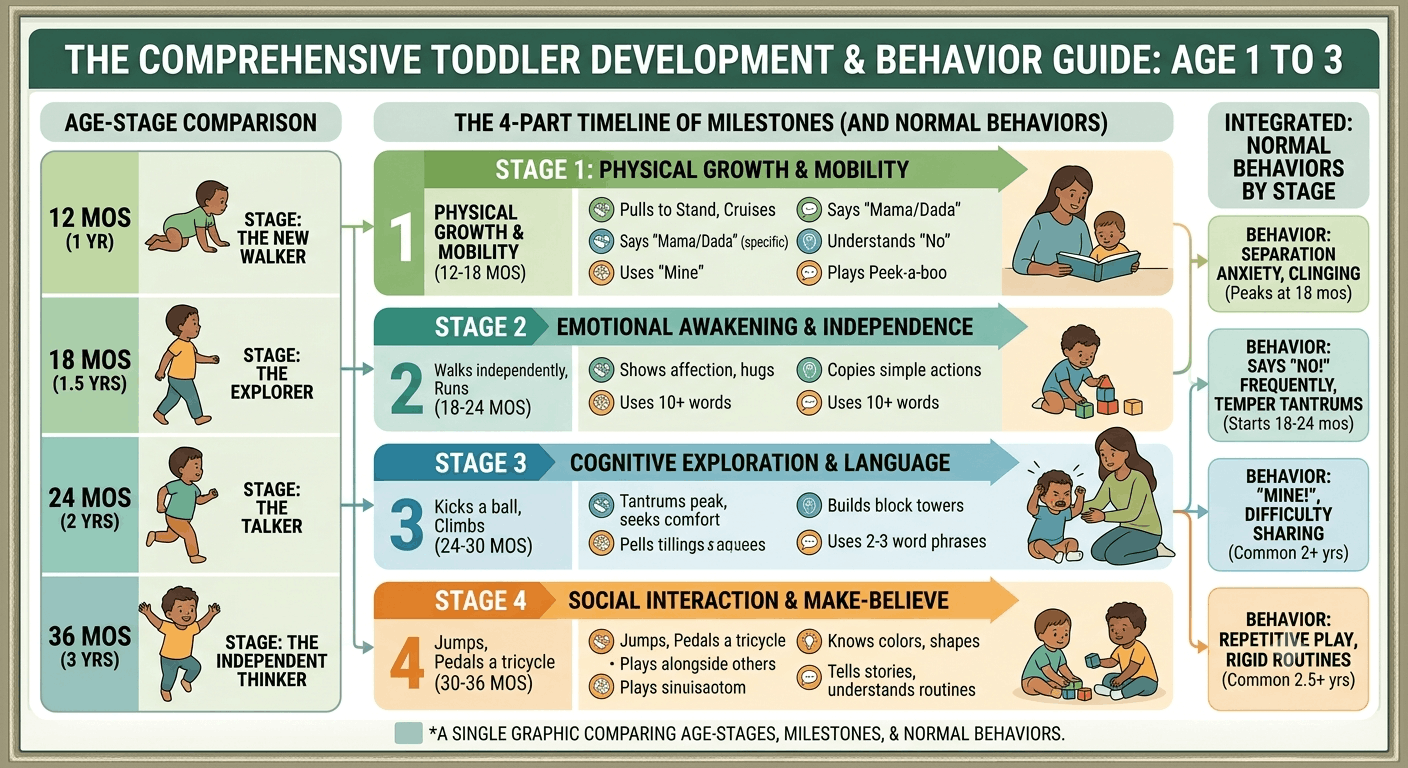
12 to 18 Months: The New Walker
This is toddlerhood in its earliest, wobbliest form. Most children take their first independent steps somewhere between 9 and 15 months, and by 12 to 18 months, walking becomes steadier, even if it’s still a little stiff-legged and prone to sudden sit-downs. Vocabulary at this stage is usually small — often just one to three words beyond “mama” and “dada” — but understanding of language is developing much faster than speech itself. Children this age also start using simple gestures, like pointing or waving, to communicate before words catch up.
18 to 24 Months: The Explorer
By a year and a half, most toddlers are walking confidently, starting to run (in a delightfully off-balance way), and beginning to climb onto furniture with a determination that catches many parents off guard. Vocabulary usually grows to around 10 to 25 words by 18 months, and language comprehension expands quickly — many toddlers can follow simple one-step instructions like “bring me the ball” well before they can say more than a handful of words themselves. This is also when pretend play starts to appear: feeding a stuffed animal, pushing a toy car and making engine noises, or “talking” on a toy phone.
2 to 2.5 Years: The Communicator
Around the second birthday, language often accelerates dramatically. Many toddlers begin combining two words into short phrases — “more milk,” “daddy go,” “big truck” — and can follow two-step instructions. Motor skills sharpen too: most two-year-olds can run more smoothly, kick a ball, and climb stairs with some support. This stage is also famous for the beginning of noticeable independence-seeking and the classic toddler tantrum, as a child’s desire to do things themselves outpaces their ability to actually do them (or communicate their frustration calmly).
2.5 to 3 Years: The Almost-Preschooler
By the time a child approaches their third birthday, many of the hallmark “toddler” behaviors are beginning to mature into early preschool skills. Sentences get longer, sometimes three to four words at a time. Pretend play becomes more elaborate and social, especially with siblings or peers. Many children this age are also beginning to show interest in toilet training, though readiness varies enormously from child to child.
Toddler vs. Infant vs. Preschooler: Where Are the Lines?
Parents often get tripped up by the fact that these categories overlap in casual conversation. Here’s a clearer breakdown of how the terms are generally used:
- Newborn: Birth to about 1 to 3 months
- Infant / baby: Birth to 12 months (these two words are often used interchangeably for the whole first year)
- Toddler: 1 to 3 years old
- Preschooler: Roughly 3 to 5 years old, until kindergarten begins
The transition points aren’t rigid on either end. A 12-month-old who isn’t walking yet is still developmentally very “baby-like” in many ways, and a mature, verbal 2-year-and-10-month-old might already be showing plenty of preschooler traits. Around age 3 to 4, in fact, is widely considered a genuine transition zone — some resources still call a 3-year-old a toddler, while others already shift them into the “preschooler” category. There’s no single official cutoff; both labels are reasonable at this age.
What Actually Changes During Toddlerhood
The one-to-three window covers an enormous amount of developmental ground, arguably more change, proportionally, than almost any other two-year stretch of a person’s life. Four broad areas of development are typically used to describe what’s happening:
Motor skills move from first steps to running, climbing, kicking a ball, and eventually jumping with both feet off the ground, usually by around age 2. Fine motor skills progress too, from clumsily stacking two blocks to building small towers, scribbling with crayons, and eventually copying simple lines or circles.
Cognitive skills expand rapidly. Object permanence (understanding that something still exists even when out of sight) solidifies. Toddlers start solving simple problems, like figuring out how to open a container or fit a shape into the correct hole in a sorting toy, and imaginative play emerges as a major way they process the world.
Language and communication go from a handful of single words to short sentences by age 3. Comprehension consistently runs ahead of spoken vocabulary, which is why a toddler can often follow multi-step instructions well before they can express a complex thought out loud.
Social and emotional development brings some of the most talked-about (and challenged-with) toddler traits: separation anxiety, a fierce new sense of independence (“me do it!”), parallel play with other children, and big, fast-moving emotions that a still-developing brain hasn’t yet learned to fully regulate. This is exactly why tantrums are considered a normal, expected part of toddlerhood rather than a behavior problem to be corrected.
My cousin Emma’s son Kabir, true to form, spent his second birthday party refusing to let anyone else hold his cake spoon, shouting “MINE” with startling conviction, and then bursting into tears thirty seconds later because the spoon touched the frosting wrong. Emma didn’t panic — she’d read enough by then to recognize this as a completely typical toddler moment, not a warning sign.
Common Toddler Behaviors Parents Should Expect (Not Worry About)
Several behaviors are so universal during this age range that pediatricians consider them a healthy, expected part of development rather than something to “fix”:
- Tantrums: A byproduct of big emotions colliding with limited communication skills and an immature ability to self-regulate.
- Separation anxiety: Often peaks between 12 and 18 months and can resurface off and on through age 2 or 3.
- Testing limits: Repeatedly doing the exact thing they were told not to do isn’t defiance for its own sake — it’s how toddlers learn where boundaries actually are.
- Picky eating: Appetite and food preferences often become far less predictable than they were in infancy.
- Short attention span: A toddler jumping from toy to toy every few minutes is completely age-appropriate, not a concentration problem.
Understanding that these behaviors are typical for the stage — not personality flaws or parenting failures — tends to make the day-to-day of toddler life considerably less stressful. Our practical parenting tips guide goes deeper into positive discipline strategies and building healthy routines that work especially well during these years.
When to Check In With a Pediatrician
Every child develops at their own pace, and a wide range of timing is considered normal. Still, it’s worth mentioning a few things to a pediatrician if they come up: no words at all by 18 months, no two-word phrases by age 2, not walking independently by 18 months, losing a previously acquired skill at any age, or very limited interest in interacting with caregivers. In most cases, these conversations end in reassurance. Occasionally, they lead to an early intervention referral — and catching things early tends to make a meaningful difference, so there’s rarely a downside to asking.
Supporting Your Toddler Through This Stage
A few simple habits go a long way during these years:
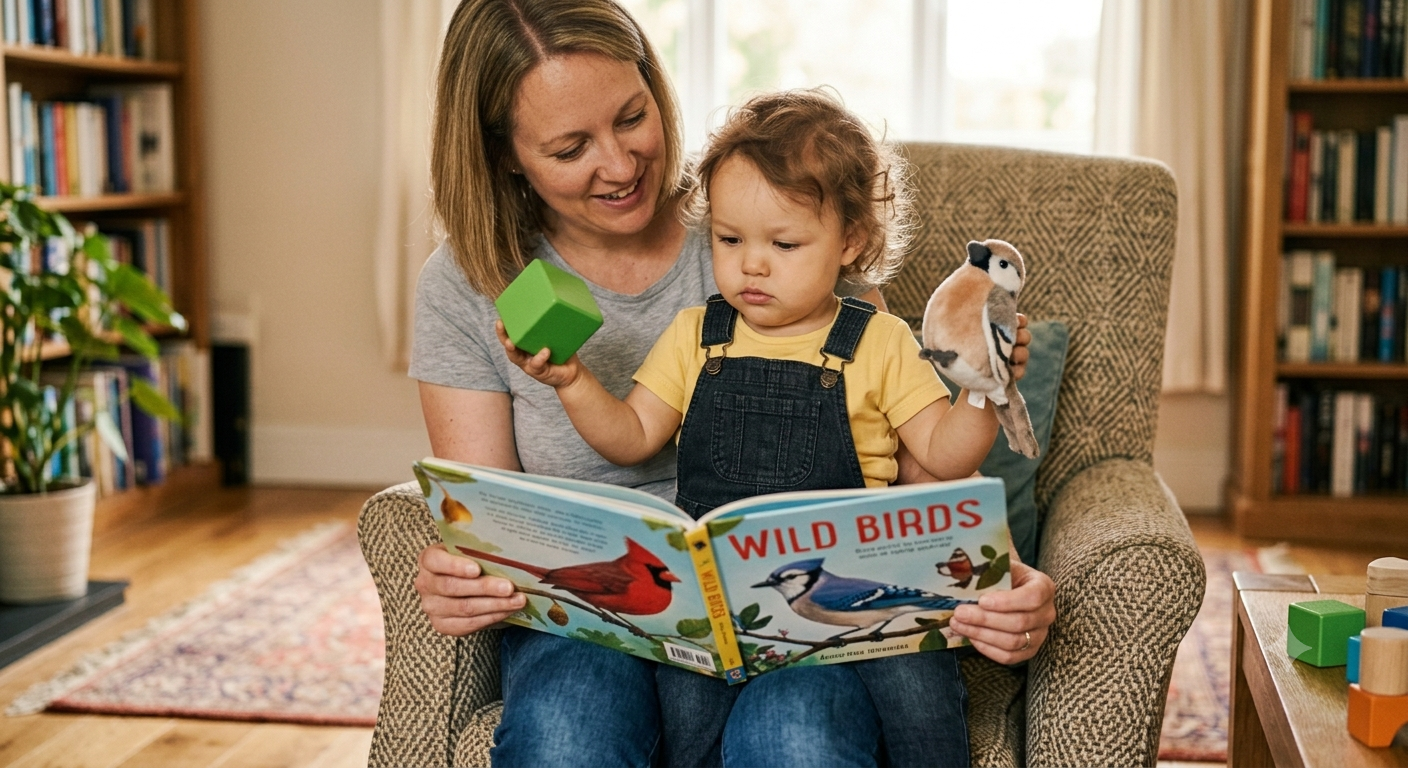
Talk constantly, even before they can respond in full sentences. Narrating your day, naming objects, and reading together all build the vocabulary that will show up in their speech a little later.
Offer small, safe choices. Letting a toddler pick between two shirts or two snacks feeds their growing need for independence without handing over more control than they’re ready for.
Keep routines predictable. Toddlers feel more secure, and tend to have fewer meltdowns, when meals, naps, and bedtime happen at roughly the same time each day.
Childproof generously. A newly mobile, endlessly curious toddler will find every unlocked cabinet and unattended stair within days.
Expect big feelings, and stay calm through them. A toddler mid-tantrum isn’t being manipulative — they’re overwhelmed. A steady, patient response teaches emotional regulation far more effectively than matching their intensity.
Frequently Asked Questions
Is a 1-year-old a baby or a toddler? Technically, once a child turns one, they’ve entered the toddler age range — but many one-year-olds are still very baby-like in behavior, especially if they aren’t walking yet. It’s common (and fine) to use both terms loosely around this age.
Is a 3-year-old still a toddler? This is genuinely a gray area. Some sources still classify 3-year-olds as toddlers, while others already consider them preschoolers. Both are reasonable, since the transition happens gradually rather than on the exact day of a third birthday.
What comes after the toddler stage? The preschooler stage follows, typically covering ages 3 to 5, until a child starts kindergarten.
Why do toddlers have so many tantrums? Toddlers experience intense emotions but haven’t yet developed the brain maturity or language skills to express or regulate those feelings smoothly. Tantrums are a normal, expected part of this developmental stage, not a discipline failure.
The Bottom Line
If you’re wondering exactly what age counts as a toddler, the simple answer is one to three years old — the stretch between a first wobbly step and the more capable, conversational child who’s about to become a preschooler. But the number matters far less than what happens during it: a toddler’s first steps, first sentences, first real opinions, and first (of many) tantrums over the wrong-colored cup. Whether your child crosses into “toddlerhood” the week they turn one or a few months later once they’re finally walking, the label is really just a way of saying: hold on, because the next two years are going to move fast.