


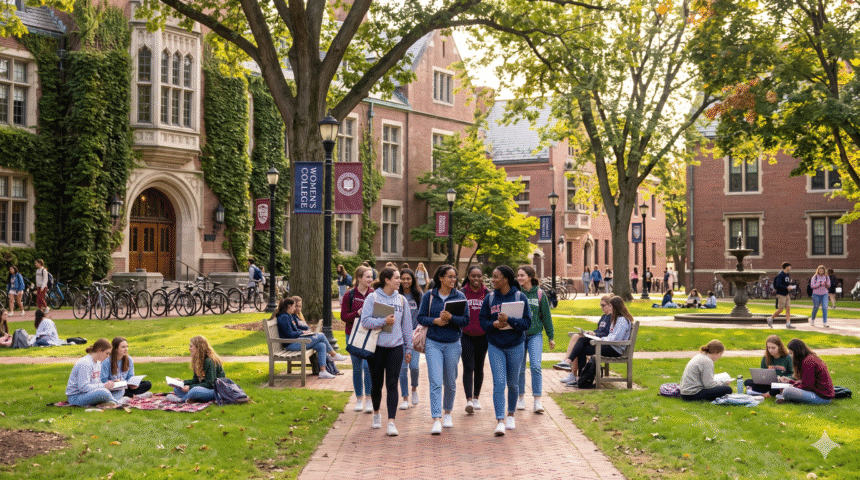
Long before women could vote, and decades before most universities admitted them, American women were building their own colleges. Women’s colleges in the United States opened doors that were closed everywhere else, and they produced scientists, senators, writers, and presidents of institutions. This article traces their history, maps where they are today, and profiles some of the most important schools.
Why Women’s Colleges Began
In the early 1800s, American universities such as Harvard, Yale, and Princeton did not admit women. Women who wanted more than a basic education had few options. Early “female seminaries” and academies filled the gap, teaching reading, writing, arithmetic, and often moral and domestic instruction. Reformers argued that educated women would make better mothers, teachers, and citizens. Over time that argument grew into a demand for rigorous college-level education equal to men’s.
Key Moments in History
1830s to 1850s: The first colleges. Georgia Female College, now Wesleyan College in Macon, Georgia, was chartered in 1836 and is widely recognized as the first college chartered to grant degrees to women. In 1837, Mary Lyon founded Mount Holyoke Female Seminary in South Hadley, Massachusetts, which later became Mount Holyoke College. Elmira College in New York opened in 1855 and was among the first to offer women a curriculum comparable to that of men’s colleges.
1860s to 1880s: The age of the great colleges. Vassar College (1861, Poughkeepsie, New York), Wellesley College (chartered 1870, opened 1875), Smith College (chartered 1871, opened 1875), and Bryn Mawr College (1885) set a new standard of academic seriousness. Spelman College was founded in Atlanta in 1881 to educate Black women, and Bennett College in Greensboro, North Carolina, traces its origins to 1873.
1889 to 1900s: Women’s colleges tied to universities. Barnard College was founded in 1889 in New York City after Columbia refused to admit women. Radcliffe College began as the “Harvard Annex” in 1879 and was chartered as Radcliffe in 1894. These institutions gave women access to the faculty and resources of elite universities while still excluded from the men’s colleges themselves.
The Seven Sisters. In the early twentieth century, seven of the most prestigious Northeastern women’s colleges came to be known as the “Seven Sisters,” a counterpart to the male Ivy League: Barnard, Bryn Mawr, Mount Holyoke, Radcliffe, Smith, Vassar, and Wellesley. Vassar became coeducational in 1969, and Radcliffe merged fully into Harvard in 1999.
1960s to 1970s: The great shift. As elite men’s colleges began admitting women, and after Title IX of 1972 prohibited sex discrimination in federally funded education, many women’s colleges chose to go coeducational or closed. Estimates commonly cite around 230 women’s colleges in the early 1960s. Today only a few dozen remain, depending on how the term is defined.
Where Women’s Colleges Are Located Today
Women’s colleges are found across the country, though women’s colleges in the United States cluster in the Northeast and the South.
Northeast
- Wellesley College, Wellesley, Massachusetts: founded 1870.
- Smith College, Northampton, Massachusetts: founded 1871.
- Mount Holyoke College, South Hadley, Massachusetts: founded 1837.
- Simmons University, Boston, Massachusetts: founded 1899, with a women-only undergraduate program.
- Barnard College, New York, New York: founded 1889.
- Bryn Mawr College, Bryn Mawr, Pennsylvania: founded 1885.
- Notre Dame of Maryland University, Baltimore, Maryland: women’s college for undergraduates.
- Trinity Washington University, Washington, D.C.: founded 1897, with a women’s undergraduate college.
South
- Spelman College, Atlanta, Georgia: founded 1881.
- Agnes Scott College, Decatur, Georgia: founded 1889.
- Wesleyan College, Macon, Georgia: chartered 1836.
- Bennett College, Greensboro, North Carolina.
- Meredith College, Raleigh, North Carolina: founded 1891.
- Salem College, Winston-Salem, North Carolina: its roots reach back to 1772.
- Hollins University, Roanoke, Virginia: founded 1842, with a women-only undergraduate program.
- Sweet Briar College, Sweet Briar, Virginia: founded 1901.
Midwest and West
- Saint Mary’s College, Notre Dame, Indiana.
- College of Saint Benedict, St. Joseph, Minnesota.
- Alverno College, Milwaukee, Wisconsin.
- Stephens College, Columbia, Missouri.
- Cottey College, Nevada, Missouri.
- Scripps College, Claremont, California: founded 1926 as part of the Claremont Colleges consortium.
Note: Enrollment policies and institutional status change over time, so check each school’s website for current details.
Profiles of Notable Colleges
Wellesley College (Massachusetts)
Founded by Henry and Pauline Durant, Wellesley sits on a large wooded campus beside Lake Waban, about 12 miles from Boston. It is known for strong liberal arts programs and a cross-registration arrangement with MIT. Notable alumnae include Hillary Rodham Clinton and Madeleine Albright.
Smith College (Massachusetts)
Smith was founded through a bequest from Sophia Smith and is the largest of the Seven Sisters by enrollment. It is home to the Picker Engineering Program, the first at a women’s college in the United States. Alumnae include Gloria Steinem and Sylvia Plath. Smith is part of the Five College Consortium with Amherst, Hampshire, Mount Holyoke, and UMass Amherst.
Mount Holyoke College (Massachusetts)
The oldest of the Seven Sisters, Mount Holyoke was founded by educator Mary Lyon, who raised money from hundreds of small donors to open the school. Its alumnae include Frances Perkins, the first woman to serve in a U.S. cabinet, and the poet Emily Dickinson attended briefly.
Bryn Mawr College (Pennsylvania)
Founded by Quakers and shaped by its early president M. Carey Thomas, Bryn Mawr was among the first institutions to offer women graduate education, including doctoral degrees. Its campus near Philadelphia is known for Gothic Revival architecture. Katharine Hepburn is among its alumnae.
Barnard College (New York)
Barnard stands on Morningside Heights in Manhattan, across the street from Columbia University, to which it is affiliated. Founded by Annie Nathan Meyer and others, it gives students access to a major urban research university. Zora Neale Hurston is one of its best-known graduates.
Spelman College (Georgia)
Spelman is a historically Black women’s college in Atlanta, founded by Sophia Packard and Harriet Giles as the Atlanta Baptist Female Seminary. It consistently ranks among the top HBCUs. Alumnae include author Alice Walker and children’s rights advocate Marian Wright Edelman. Spelman and Bennett are the nation’s two historically Black women’s colleges.
Agnes Scott College (Georgia)
Located in Decatur near Atlanta, Agnes Scott is a small liberal arts college known for its global learning programs and close faculty relationships.
Sweet Briar College (Virginia)
Sweet Briar occupies a campus of roughly 3,000 acres in the Blue Ridge foothills. In 2015 its board announced it would close, but alumnae, donors, and legal action kept it open, becoming one of the most striking rescue stories in higher education.
Scripps College (California)
Founded by Ellen Browning Scripps, the college is part of the Claremont Colleges consortium, giving its students access to courses across five undergraduate campuses.
Challenges and Change
Women’s colleges in the United States have faced financial pressure, rising costs, and declining interest in single-sex education. Some have closed or merged: Mills College in Oakland, California, merged with Northeastern University in 2022, and Wells College in New York closed in 2024. Others have become coeducational or opened their graduate programs to all genders.
Many have also revisited admissions policies on transgender and nonbinary students, a topic on which institutions have taken different approaches.
Why Women’s Colleges Still Matter
Supporters of women’s colleges in the United States point to several strengths: leadership opportunities in every campus role, small classes, strong alumnae networks, and a history of success in producing graduates in science, public service, and business. Critics note that single-sex education is not for everyone and that coeducation is now the norm. Either way, these colleges changed the course of American education and remain a vital part of its landscape.
Conclusion
From Georgia Female College in 1836 to Scripps in 1926 and beyond, women’s colleges in the United States grew out of a simple conviction: that women deserved a serious education. Though their number has shrunk, the institutions that remain continue to graduate leaders and carry forward a distinctive history, from the green hills of Massachusetts to the streets of Atlanta and the California foothills.
Related Reading on Famousparenting Momlife
If you are a mom or parent thinking about your daughter’s future education, these pages from Famousparenting Momlife may help:
- Famousparenting Momlife: The Complete Guide to Real Motherhood, Every Stage: support and ideas for every stage of raising children, from newborn to teen.
- A Year-By-Year Guide to the Different Generations: understand how each generation views education and family life.
- Mom Life: everyday stories and advice for moms.
- Parents: guidance for parents, stage by stage.
- About Us: meet Amelia and learn what the site is about.
- Blog: browse all the latest articles.