


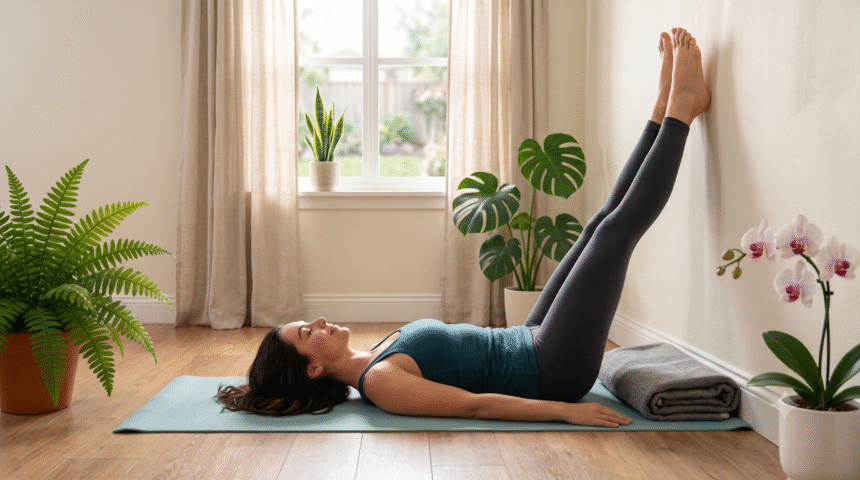
Lie on the floor, rest your legs against a wall, and stay there for a few minutes. That is the whole pose. It is called Viparita Karani in yoga, and it has stayed popular for years because it asks almost nothing of you: no flexibility, no strength, no class.
The trouble is that many articles promise far more than a five-minute rest can deliver. Detox, cured headaches, and lower blood pressure show up in a lot of lists. This guide sorts the benefits by how well they are supported, shows you how to do the pose comfortably, and is honest about who should be careful.
What is the legs up the wall pose?
Viparita Karani appears in yogic texts as far back as the 17th century, and the name combines the words for “reversed” and “in action.” It is a restorative pose, which means you hold it passively and let the position do the work instead of straining a muscle group. If you are new to slow, hold-based practice in general, this beginner’s guide to hatha yoga explains the style this kind of pose sits alongside.
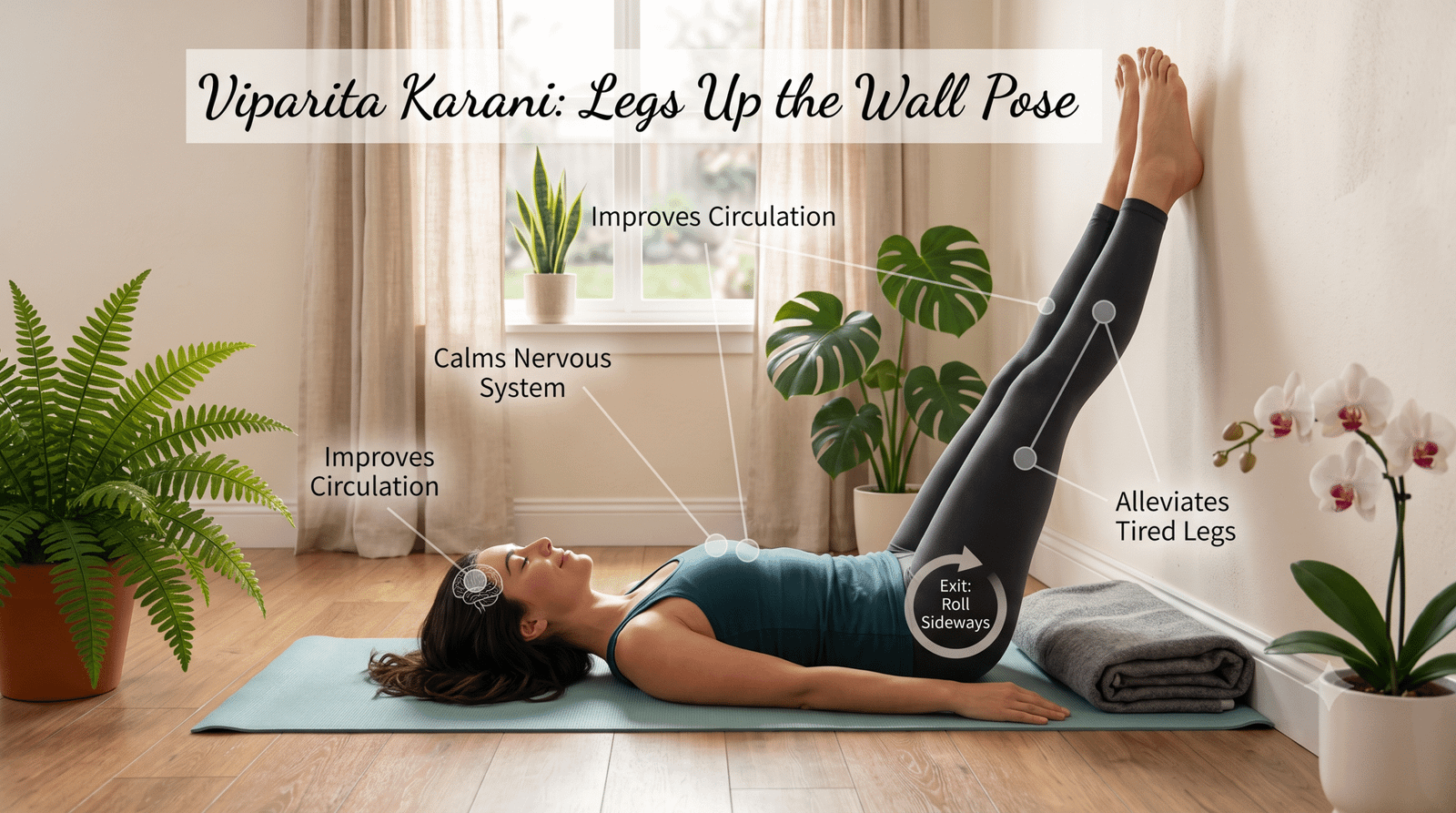
Peloton instructor Anna Greenberg describes it as a passive inversion in which your upper body rests on the floor while your lower back and pelvis are supported and your legs rest against the wall. Because it is a gentle inversion, your head stays close to the ground and your neck carries no weight, which is one reason beginners find it easier than headstands or shoulder stands.
The benefits, ranked by how well they are supported
1. Tired, swollen legs and feet (the strongest case)
If you stand or sit for long hours, fluid can collect in your lower legs by evening. A Cleveland Clinic physician explains that holding an inverted position helps blood flow back and reduces swelling in the lower legs. Raising the legs to reduce swelling is basic physiology, and it is the same idea doctors use when they suggest elevating a swollen ankle.
This tends to help most after:
- A full day at a desk
- Standing jobs such as teaching, retail, or nursing
- Long flights or car journeys
- A long walk, hike, or run
Peloton’s guide notes that the effect can be felt almost right away as blood drains from the feet, and a few minutes may noticeably reduce swelling. That matches what many people report, though results differ from person to person.
2. Relaxation and stress relief
This is where most people notice the difference. Cleveland Clinic’s Dr. Saper says many patients describe holding the pose as very calming, but he frames this as anecdotal, meaning based on personal reports. It is worth being clear on why it probably works: lying still, with your legs supported and your breathing slowed, is a low-effort way to signal to your body that it can stand down. The leg position may matter less than the stillness.
Try a simple pattern: breathe in for a count of four and breathe out for a count of six. Slow, long exhales are commonly used to encourage a relaxed state.
3. Winding down before sleep
A few minutes with slow breathing can help shift the body toward its rest state and quiet a busy mind, which supports sleep. Think of the pose as a wind-down routine, not a treatment for insomnia. If you have trouble sleeping most nights, the pose alone is unlikely to fix it, and it is worth speaking to a doctor.
There is some early evidence, too. One study found that a yoga practice that included legs up the wall reduced sleep disturbances in people with PMS. That study looked at a whole practice, not this pose alone, so do not read it as proof that this one pose improves sleep.
4. Mild relief of stiff legs and a tired lower back
Some sources describe the pose as easing tired legs, cramping in the legs and feet, and backaches, and as gently opening the backs of the legs. Support for this is mostly experience-based. If your hamstrings are tight, the pose can feel like a strong stretch instead of a rest, and the chair version below will suit you better.
Also Read : What Is Hatha Yoga? A Complete Guide to This Ancient Practice
What is weakly supported or overstated
You will see claims that the pose detoxes the body, cures headaches, or lowers blood pressure. Healthline notes that research on the specific benefits of this pose is limited. It does add that a 2024 review suggests it may be a safe pose for people with high blood pressure, possibly because it supports circulation and lymphatic flow, but “may be safe” is not the same as “treats high blood pressure.”
Olaben makes a similar point: the bigger claims, such as detoxing the body or curing conditions, are not backed by good science, and the pose is best treated as a low-risk way to relax and reduce swelling. I agree with that framing. Read it as a helpful habit, not a medical treatment.
Why this pose suits busy parents
Parents spend a large part of the day on their feet: carrying a child, cooking, cleaning, and running around the house and school schedule. Legs feel heavy by evening. Five minutes on the bedroom floor after the kids are asleep is one of the few wind-down routines that needs no equipment, no class, and no free hour.
A few practical ideas:
- Do it while a baby naps, if you can safely rest nearby.
- Use the bed version (below) if getting down to the floor is hard.
- Keep it short. Five minutes done regularly beats twenty minutes done once.
If you are postpartum, recovering from a C-section, or had complications, ask your doctor before starting.
How to do it step by step
- Set up. Find a bare stretch of wall and a bit of floor. A mat or folded blanket makes it more comfortable.
- Sit sideways. Sit with your right hip against the wall, knees bent.
- Swing up. Lie back and swing your legs up the wall as you turn, so your back is flat on the floor.
- Adjust. Scoot your hips close to the wall so your legs are fully supported and your body forms an “L” shape, with your arms by your sides and palms facing up.
- Stay. Some sources suggest 5 to 20 minutes with deep, calm breathing. Five to ten is plenty for most people.
- Come out slowly. Bend your knees, roll to one side, and rest for a moment before sitting up. Rising too fast can make you dizzy.
Comfort tips:
- If your lower back feels strained, slide a folded blanket or firm pillow under your hips.
- If the backs of your legs pull too hard, move your hips slightly away from the wall. Your knees may stay a little bent.
- Keep your neck neutral. A thin folded towel under the head can help.
Variations if the wall does not work for you
The wall is convenient, but it is not required. You can rest your calves on a chair seat with your knees bent at about 90 degrees, which is easier on tight hamstrings.
| Version | Best for | How |
|---|---|---|
| Wall (classic) | Most healthy adults | Hips near the wall, legs straight up |
| Chair | Tight hamstrings, sore back | Calves on a chair seat, knees bent at 90° |
| Bed or headboard | Bedtime routine, limited mobility on the floor | Legs against the headboard or stacked pillows |
| Angled legs | Feeling too much pressure in the head | Legs on a bolster at a gentle slope instead of vertical |
Common mistakes
These come from general yoga practice, not a single study, but they are the ones that most often spoil the pose:
- Hips too close when your hamstrings are tight. You end up straining instead of resting. Move back a few inches.
- Forcing the knees straight. A soft bend is fine.
- Staying too long. More time is not more benefit, and your legs may go numb.
- Scrolling on your phone. You lose the calming effect if you are still busy. Try closing your eyes or using a timer.
- Standing up quickly. Come out slowly, as described above.
Who should be careful or skip it
This is where sources disagree, so here is the safest reading.
Ask a doctor first if you have:
- Glaucoma or retinal problems. People with glaucoma, retinal disease, or a recent eye procedure should ask their eye specialist first, since these positions may raise eye pressure.
- High blood pressure. Peloton advises checking with your doctor because of increased pressure from being inverted for a long time. Another source suggests, for mild high blood pressure, keeping the legs at a gentle angle of 30 to 45 degrees and limiting the time to 3 to 8 minutes. Treat that as a starting point to discuss with your doctor, not medical advice.
- A hernia or heart condition. YogaUOnline lists hiatal hernia and heart conditions among the reasons not to invert.
- Serious neck or back problems.
Pregnancy: Advice varies. Peloton says that after 20 weeks you should modify the pose by raising your torso at an angle so you are not lying flat on your back, because of pressure on the vena cava, a vein that carries blood to the heart. Another medical source says pregnancy is not automatically a reason to avoid gentle leg elevation, but that lying flat later in pregnancy can make some people lightheaded. A third source says women who are pregnant or menstruating should avoid the pose entirely. With this much disagreement, ask your doctor or midwife instead of relying on a general article. Legs Up The Wall Pose: How to Do It and the Benefits | The Output by Peloton +2
Stop right away if you feel dizzy, feel pressure in your head, or notice numbness or tingling in your legs.
Also, if one leg is suddenly swollen, red, warm, or painful, do not treat it with a yoga pose. Contact a doctor promptly, since that can signal a blood clot.
A simple 10-minute evening routine
If you want to use the pose as a wind-down, this order works well for many people:
- Two minutes of slow walking or gentle stretching to loosen the legs.
- Five minutes in legs up the wall with slow breathing.
- A moment in Child’s pose after the hold, then sit up slowly.
- Lights down, phone away.
FAQs
How long should I stay in the pose?
Five to ten minutes is enough for most people. Some sources go up to twenty, but there is no proof that longer is better.
Can I do it every day?
For most healthy people it is gentle enough for daily practice, and many do it every evening to unwind or de-swell tired legs. If you have a health condition, follow your doctor’s advice.
Is it good before bed?
It can be a helpful part of a bedtime routine, mainly because it encourages stillness and slow breathing.
Do I need a wall?
No. A chair or the headboard of a bed works too.
Should I do it right after a meal?
It is more comfortable to wait a while, since lying with your legs raised can feel uncomfortable on a full stomach. This is practical comfort advice, not a studied rule.
Is it safe if I have varicose veins?
One source describes it as generally supportive for varicose veins, with advice to enter and exit slowly and keep the legs slightly bent if pressure increases. Ask your doctor if the veins are painful or swollen.
The takeaway
Legs up the wall is not a cure for anything. It is a free, five-minute way to ease tired legs and slow down at the end of a day, and the best-supported benefit is simple: gravity helps fluid drain from your lower legs. The relaxation benefit is real for many people, though it is based more on experience than on strong studies.
Try it for a week. If it helps you unwind, keep it. If you have an eye, heart, blood pressure, or pregnancy concern, ask your doctor first. For a deeper look at the research and step-by-step guidance, the Cleveland Clinic overview and Healthline’s guide are good places to co