

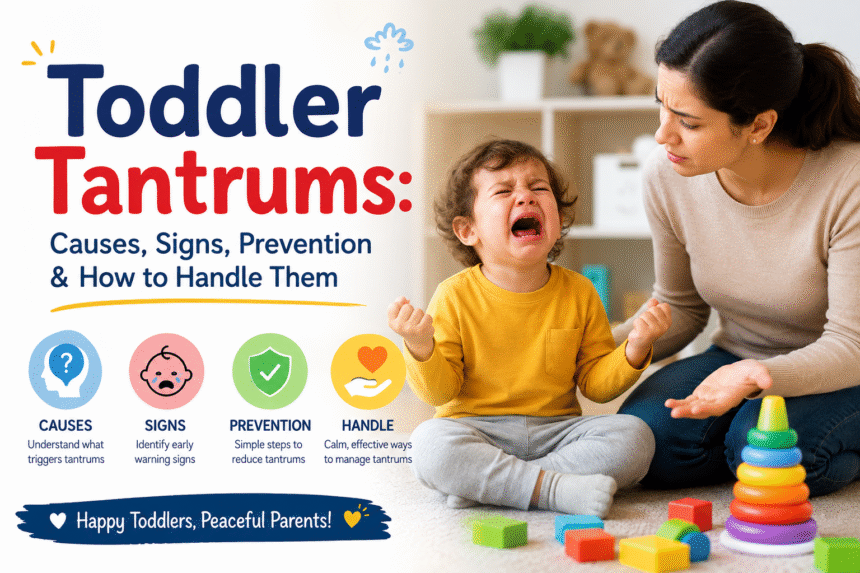
The first time my daughter dropped to the kitchen floor screaming because I’d cut her toast into triangles instead of squares, I genuinely thought something was wrong. Not with the toast — with her, with me, with whatever I’d apparently broken in the last thirty seconds. Twenty minutes later she was eating the same “wrong” toast without a word about it. That’s when it clicked: this is just what two years old looks like sometimes. Nobody warns you how often the crisis and the resolution have nothing to do with each other.
If you landed here after your own version of that — cereal shaped wrong, socks that felt “weird,” a banana that broke in half when you peeled it (a real one, ask any parent) — this is the guide I wish someone had handed me back then. Not a checklist copied from a parenting textbook, but something that actually explains what’s going on, what to watch for before it blows up, and what genuinely helps once it does.
What’s Actually Happening in a Tantrum
A tantrum isn’t your toddler being manipulative or “bad.” It’s what happens when their emotions move faster than their ability to manage them. The part of the brain responsible for impulse control and emotional regulation is still years from being finished — some of it isn’t fully wired until the mid-twenties, honestly — so a two or three-year-old is working with what they’ve got, which isn’t much yet.

So when your toddler screams, drops to the floor, throws the cup, or holds their breath because you said no to a cookie before dinner, they’re not scheming against you. They’re overwhelmed and don’t have another way to show it. Doesn’t make the floor any less hard when you’re kneeling on it at 6pm trying to talk someone down, but it helps to know it’s not personal.
What Actually Causes Toddler Tantrums
Most tantrums have a reason underneath them, even when the trigger on the surface looks completely random.
Frustration they can’t put into words
Toddlers understand more than they can say out loud. When the right word won’t come, or you genuinely can’t figure out what they’re asking for, that gap turns into a meltdown fast.
Hunger and being overtired
Unglamorous, but true — this is behind more tantrums than anything else on this list. A toddler who skipped a nap or is thirty minutes past snack time has almost nothing left in the tank for disappointment.
Too much going on around them
Loud stores, crowded parties, one errand stacked on another — sensory overload builds up quietly and then cashes out all at once, usually over something small.
Wanting control they’re not allowed to have
Somewhere around age two, toddlers develop a fierce need to decide things — what to wear, what to eat, when to leave — while still being almost entirely dependent on you for all of it. That gap is a constant source of friction, and it doesn’t fully close for a while.
Testing where the line actually is
Some of it is just toddlers checking whether “no” really means no today, or if it’s negotiable. It’s not defiance the way we’d read it in an adult — it’s how they figure out what’s consistent.
Big changes at home
A new sibling, a move, starting daycare, even the clocks changing — these often show up a few weeks later as more frequent, more intense meltdowns, seemingly out of nowhere.
Early Signs a Tantrum Is Coming
Most tantrums don’t go from calm to screaming in zero seconds. There’s usually a short window before, if you know what to look for:
- Whining, or their voice climbing higher than usual
- Fists clenching, body going stiff
- Repeating the same demand louder and faster
- Sudden clinginess, or the opposite — pulling away and refusing to be touched
- Eye-rubbing or yawning (tired), or hovering near the pantry (hungry)
- Getting stuck on one specific thing and refusing to move past it
Every kid’s warning signs look a little different. Mine goes quiet right before he melts down — genuinely goes still, which took me way too long to recognize as a red flag instead of a good sign. A friend’s daughter does the opposite, gets louder and louder for a full minute first. Watch a few (yes, even while it’s happening, which is hard) and you’ll start to notice the pattern that’s specific to your own kid.
How to Prevent Toddler Tantrums (As Much as That’s Possible)
You will not prevent every single tantrum, and trying to will wear you out faster than the tantrums themselves. But a few things genuinely cut down how often and how hard they hit.
A predictable routine helps more than it should. Regular meals, regular naps, a bedtime that doesn’t move around too much — it gives toddlers a sense of “I know what’s happening next,” which lowers the baseline stress that tantrums grow out of. We go into how to actually build one (without turning your house into a military schedule) in practical FPMomLife parenting tips.
Offer choices, not open freedom. “Red cup or blue cup?” gives them the feeling of control without handing over a decision they’re not ready to make on their own.
Give a heads-up before transitions. “Five more minutes, then we’re leaving the park” gives their brain time to adjust instead of getting cut off mid-swing with zero warning.
Plan around their worst hours, not your ideal schedule. If errands always go sideways around 11am because that’s too close to lunch and nap, stop scheduling errands at 11am. It sounds obvious written down. It took me months to actually apply it.
Pick your battles on purpose. Mismatched socks, toast shape, which cup — not worth the fight. Safety, hitting, kindness — worth holding the line every time. Deciding this in advance, before you’re standing in the moment, makes it much easier to stay consistent.
Name the feeling before it tips over. Even a simple “I can see you’re getting frustrated, do you need a minute?” at the very first sign sometimes — not always — heads off the bigger blowup entirely.
How to Handle a Tantrum When It Happens Anyway
Prevention only goes so far. When a full tantrum hits:
- Get yourself calm first. This is the hardest one and the most important one. Toddlers pick up on your energy faster than they pick up on your words.
- Get down to their level. Crouching down and speaking quietly does more than talking down at them from standing height ever will.
- Prioritize safety over comfort. If they’re hitting, biting, or somewhere unsafe, move them calmly. You don’t have to fix the emotion instantly — just manage the moment.
- Skip the logic for now. Explaining “why” mid-meltdown doesn’t land. Their brain isn’t in a place to process it yet. Save it for after.
- Hold the boundary you set. If the tantrum started over a “no,” giving in mid-scream teaches that a loud enough reaction changes the answer. This one is uncomfortable in the moment and pays off over weeks, not minutes.
- Reconnect once it’s over. A short, warm “That was a hard one, huh — I’m right here” tends to help more than any lecture about behavior.
If most of your tantrums happen specifically out in public — grocery stores, restaurants, someone else’s living room — we wrote a much more detailed, in-the-moment breakdown in toddler tantrums in public, including the stuff that didn’t work for us before we figured out what did.
And if tantrums are just one part of a bigger discipline question you’re working through right now, 9 effective parenting strategies every parent should know covers the wider picture — consistency, boundaries, and what actually changes as kids get older.
When to Talk to Your Pediatrician
Most tantrums are a normal, if exhausting, stage — not a red flag. Still, it’s worth mentioning at your next appointment if:
- Tantrums regularly run past 25 minutes
- Your child is hurting themselves or others during meltdowns
- Intense tantrums are still frequent well past age 4
- You notice a sudden jump in frequency or intensity with no obvious cause
None of these mean something is necessarily wrong. They’re just worth flagging so your pediatrician can take a look and give advice specific to your kid, not a general list like this one.
The Part Worth Remembering
Tantrums feel personal in the moment, especially the loud, public ones. They’re not. They’re a normal, temporary stage that comes from a brain that’s still under construction. The same toddler screaming on your kitchen floor over triangle toast today is, in a year or two, going to be the kid who tells you calmly that he’s upset instead of losing it completely. You’re not failing when it happens. You’re just in the middle of the actual, unfiltered work of raising a small person — the same work every other mom in this community is doing too, whether she posts about it or not.
Frequently Asked Questions
At what age are tantrums the worst? They typically peak somewhere between ages 2 and 3 — hence the term “terrible twos” — though for a lot of kids it stretches comfortably into three and sometimes beyond.
Are tantrums a sign of a behavior problem? On their own, no. Occasional tantrums are a completely normal developmental stage. What matters more than the fact that they happen is the frequency, intensity, and how long they last.
Should I give in during a tantrum just to stop the crying? Giving in occasionally won’t undo anything. But consistently caving during tantrums tends to reinforce them over time, because the child learns a big enough reaction gets a different outcome.
How long do toddler tantrums usually last? Most run somewhere between 2 and 15 minutes. If they’re regularly going much longer than that, or happening many times a day, it’s worth a quick mention to your pediatrician.
Related Reads on FamousParenting MomLife
- Toddler Tantrums in Public: How to Handle Them Without Losing It
- Practical FPMomLife Parenting Tips Every Parent Should Know
- 9 Effective Parenting Strategies Every Parent Should Know
- The Complete Guide to Pregnancy Due Date Calculator
- The Complete Guide to Baby Girl Names
- Blossoming into Parenthood: An Unconventional Baby Shower Guide
- More from Parents · More from Mom Life