



It is 6:45 p.m. Dinner is nowhere close to ready, the house is a little chaotic, and your newborn, who finished a full feed barely forty minutes ago, is rooting at your shirt again. You feed her. She settles. You carefully try to put her down, and within minutes she is crying and searching for the breast once more. By 9 p.m. you have lost count of the feeds, and a small, tired voice in your head asks the question almost every new parent asks: am I doing something wrong?
You are not. What you are describing is cluster feeding, one of the most common and most misunderstood newborn behaviours. It is intense, it is tiring, and it can make even confident parents doubt their milk supply. But in the vast majority of babies, it is a normal and temporary part of healthy development.
In this guide we cover what cluster feeding is, why babies do it, how to recognise it, how long it lasts, how to tell it apart from real feeding problems, what to do if you formula feed, fifteen practical survival tips, how partners and family can help, and exactly when to call your pediatrician. If you want more support for this stage of life, our Mom Life Famousparenting page and the Complete Guide to Real Motherhood, Every Stage are good companions to this article.
Quick Takeaways
- Cluster feeding means a baby wants several short feeds close together, often every 30 to 60 minutes, for a few hours at a time.
- It is most common in the evening and during growth spurts, and it can happen to breastfed and formula-fed babies.
- How often your baby feeds tells you much less than what comes out the other end and how your baby is growing. Diapers, swallowing, alertness and weight gain are the real measures.
- Cluster feeding usually peaks in the first weeks and eases as your baby gets older and feeds more efficiently.
- Call your pediatrician if your baby has fewer wet diapers than expected, is very sleepy, has a fever, or is not gaining weight.
Please note: this article is for general education and does not replace personal medical advice. Every baby is different, so when you are unsure, ask your pediatrician or a board-certified lactation consultant (IBCLC).
What Is Cluster Feeding?
Most newborns feed about 8 to 12 times in 24 hours. On a calm day that might look like a feed every two to three hours. Cluster feeding is what happens when several of those feeds bunch together. Instead of a neat gap, your baby may want to nurse or take a bottle every half hour or hour for a stretch, sometimes for three or four hours, and then fall into a longer, deeper sleep.

The word to remember is pattern. Cluster feeding is not a disease, and it is not a diagnosis. It is a feeding pattern that many babies show at some point in the first months of life. Some babies do it every single evening. Others only do it during a growth spurt. A few barely do it at all, and that is normal too.
Two things often confuse parents:
- Cluster feeding is not always about hunger alone. In a newborn, hunger, comfort, and the need to be close to you are tangled together. Sucking is how your baby calms down, regulates their body, and feels safe.
- Cluster feeds are often short. A baby may take a few minutes at the breast, doze, and wake up wanting more as soon as you move. That is typical and does not mean the feeds are ineffective.
Cluster feeding vs. a regular feeding pattern
| Regular feeding | Cluster feeding | |
|---|---|---|
| Gap between feeds | About 2 to 3 hours | About 20 to 60 minutes |
| Timing | Spread through the day and night | Bunched into a few hours, often the evening |
| Length of feeds | Often 10 to 30 minutes | Often shorter, with lots of on-off feeding |
| What follows | Baby sleeps for a short stretch | Baby often sleeps a longer stretch afterwards |
| How long it lasts | Ongoing | A few hours a day, or a few days during a spurt |
Why Do Newborns Cluster Feed?
There is rarely a single reason. Most of the time, several things are happening together. Here are the most common explanations.
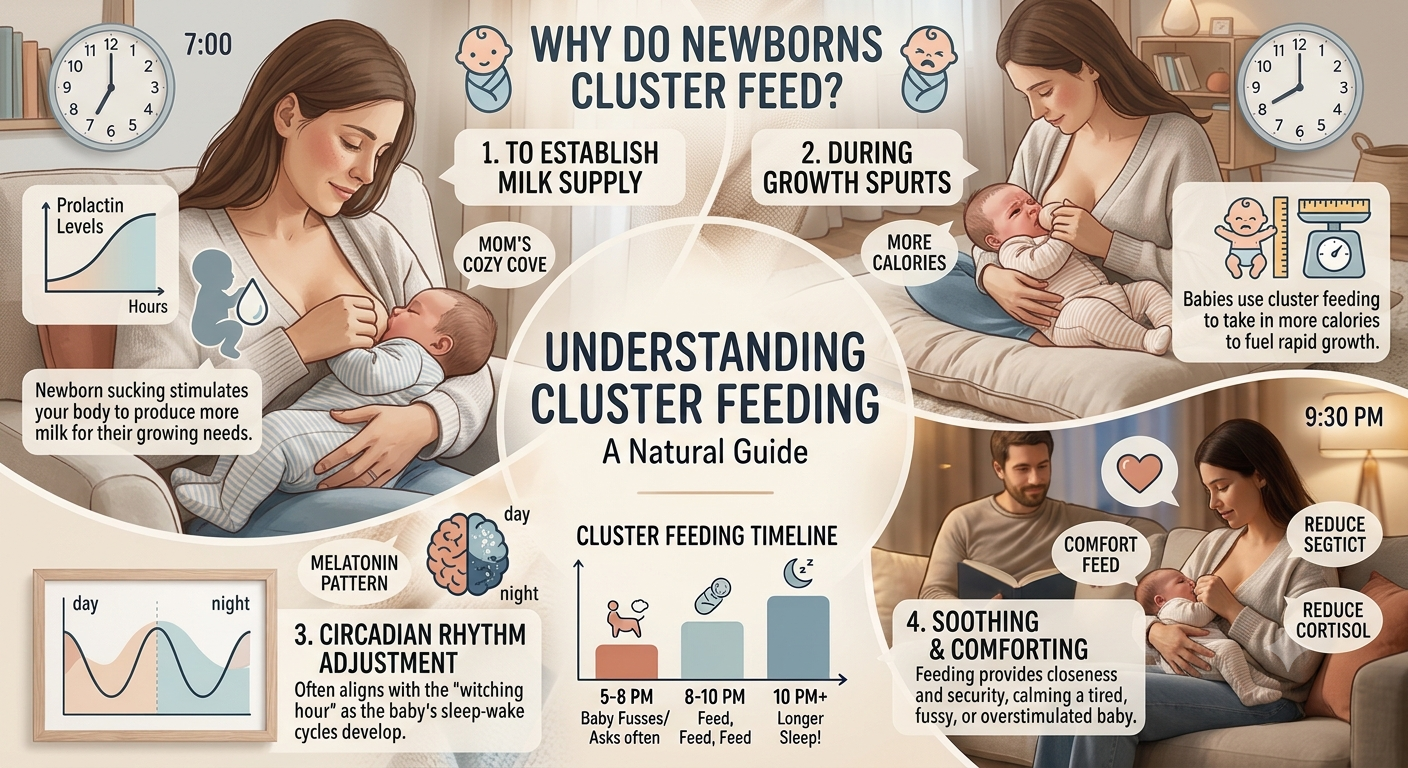
1. Newborn stomachs are tiny
A newborn’s stomach is often compared to a cherry on the first day of life and a walnut by about day three. By the end of the first month it is closer to the size of a large egg. Breast milk is digested quickly, so a tiny stomach empties quickly, and hunger returns soon. Frequent small meals are exactly what a baby’s body is designed to handle.
2. Your baby is building your milk supply
Breastfeeding works on supply and demand. When your baby nurses, hormones such as prolactin and oxytocin tell your body to make and release more milk. In the early weeks your baby is, in effect, placing an order for the supply they will need over the coming months. Frequent feeding in the first weeks helps establish a strong supply, which is why cluster feeding is often most noticeable when your mature milk is coming in, around days 3 to 5.
3. Growth spurts
Many parents notice a sudden jump in appetite around 2 to 3 weeks, again near 6 weeks, and again around 3 months. Growth spurts are not exact and not every baby has them on schedule, but the pattern is common. Your baby needs more milk for a few days, so they nurse more often to increase your supply, and then things settle down. If you want to know exactly where your baby is on the calendar, our Baby Age Calculator shows your baby’s age in weeks and days, which makes it easier to spot whether a rough patch lines up with a typical spurt.
4. The evening effect
If your baby is fussy and hungry from late afternoon until bedtime, you are in very good company. Several things may be going on at once. Some research suggests that milk made later in the day can be higher in fat, and babies often feed a lot before a longer sleep stretch. Babies are also tired and overstimulated by the end of the day, and nursing is their way of winding down. Crying in babies also tends to peak around 6 to 8 weeks, often in the evening, which is part of what is sometimes called the witching hour.
5. Comfort and closeness
Before birth, your baby lived in warmth, motion, and constant sound. Life outside is bright, loud, and new. Being held at the breast or with a bottle brings back warmth, your heartbeat, and your smell. Comfort nursing is not a bad habit and not manipulation. It is a baby doing what babies are designed to do.
6. A slow or inefficient feed
Sometimes a baby cluster feeds because they are not getting milk quickly enough. That can happen with a shallow latch, a tongue or lip tie, a sleepy baby who falls asleep early, or low milk transfer. This is the main reason why diapers, swallowing, and weight matter more than frequency. We cover how to tell the difference below.
7. Developmental leaps and a changing routine
As babies grow, they are taking in far more than we realise. A busy day with visitors, a trip, or lots of new sights and sounds can lead to extra feeds in the evening, as can teething in older babies or a mild cold. Feeding is how babies process the world and soothe themselves.
8. Your baby is simply wired that way
Some babies are small, frequent feeders by nature. Two healthy babies can have very different appetites and temperaments. If your baby is growing well, comfortable between feeds and has plenty of wet and dirty diapers, there is nothing to fix.
Signs Your Baby Is Cluster Feeding

How do you know it is cluster feeding and not something else? Look for a combination of these signs:
- Your baby has a full feed and then wants to eat again within 30 to 60 minutes.
- Feeds are bunched into a particular window, often the late afternoon or evening.
- Your baby is fussy or restless when put down but calms down at the breast or bottle.
- Hunger cues return quickly: rooting, turning the head, smacking or licking the lips, sucking on hands or clothing.
- Your baby swallows well during feeds, with a steady rhythm of suck, swallow, breathe.
- After the cluster, your baby falls into a longer, more settled sleep.
- Your baby has enough wet and dirty diapers and is gaining weight appropriately.
Notice the last two points. A baby who cluster feeds but is otherwise healthy, alert, and growing is usually doing exactly what newborns are meant to do.
When Does Cluster Feeding Start, and How Long Does It Last?
There is no single schedule. Here is a general guide to what many families experience0.

| Age | What you may see |
|---|---|
| First 24 to 48 hours | Frequent, short feeds as baby learns to feed and takes small amounts of colostrum |
| Days 2 to 5 | Intense feeding as your milk comes in, often the most demanding period for new parents |
| Weeks 2 to 3 | A common first growth spurt, with a few days of extra feeds |
| Weeks 4 to 8 | Regular evening cluster feeding and fussiness, often peaking around 6 weeks |
| Around 3 months | Another common growth spurt, which can last a few days |
| 4 to 6 months and beyond | Becomes less frequent, though short bursts can return with spurts, illness, or teething |
A single cluster usually lasts a few hours. A growth spurt usually lasts two to four days. Evening cluster feeding can continue daily for several weeks and then gradually fade as feeds become quicker and your baby’s sleep matures.
If your baby seems to be feeding constantly day and night for many days in a row, and especially if you are also seeing other worrying signs, it may not be cluster feeding. That is the time to speak to your pediatrician or a lactation consultant rather than waiting it out.
Is It Cluster Feeding or Low Milk Supply?
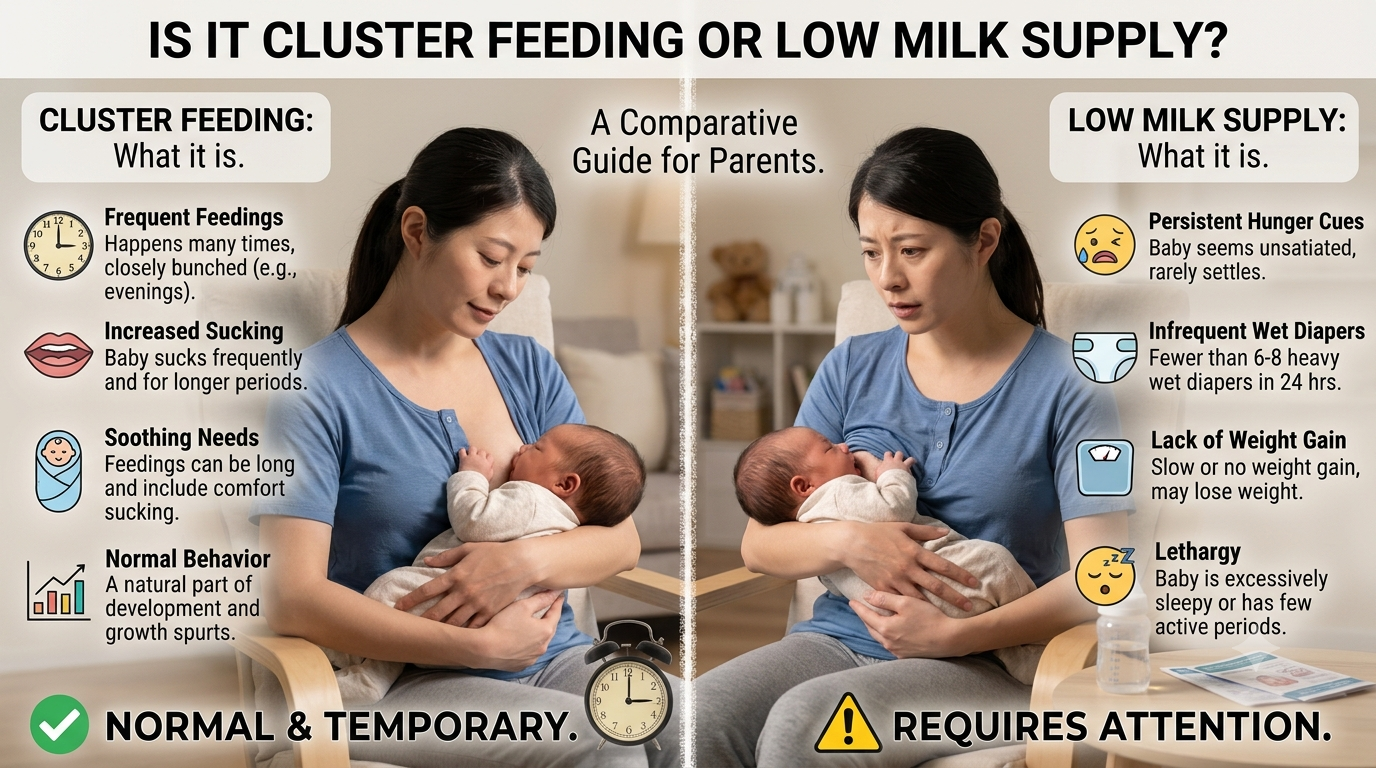
This is the question that keeps many mothers awake. When a baby wants to feed constantly, it is natural to worry that your body is not making enough. In most cases the answer is no, and frequent feeding is itself part of how supply is built. But frequency alone cannot answer the question. Look at the whole picture.
| Reassuring signs | Signs to get help |
|---|---|
| You can see or hear your baby swallowing | Little or no swallowing, or lots of clicking noises |
| About 6 or more wet diapers a day after the first week | Fewer wet diapers than expected, or dark urine |
| Yellow, seedy stools by about day 5 | Few stools, or stools that stay dark or green after the first days |
| Baby is alert when awake and content for a while after feeds | Baby is very sleepy, floppy, or hard to wake for feeds |
| Breasts feel softer after feeding | Painful latch, damaged or flattened nipples after feeds |
| Baby regains birth weight by about 10 to 14 days and keeps gaining | Weight loss continues or birth weight is not regained on time |
A few other points are worth knowing:
- Soft breasts do not mean low supply. After the first few weeks, breasts adjust and may feel softer even when milk production is perfectly healthy.
- Pumping output is not a reliable test. How much you can pump says more about the pump, the timing, and your stress levels than about what your baby takes directly.
- Short feeds can still be effective. What matters is milk transfer, which you can judge by swallowing and diapers.
If you notice several signs from the right-hand column, contact your pediatrician or an IBCLC promptly. Early help for latch problems or low milk transfer is easier, and many issues can be fixed.
Other Reasons a Baby Might Seem Constantly Hungry
Cluster feeding is common, but it is not the only reason a baby feeds a lot. Some other possibilities:
- Reflux. Babies with reflux may feed often because small, frequent feeds feel soothing. Signs that deserve a medical check include frequent forceful vomiting, arching, pain during or after feeds, poor weight gain, or refusing feeds.
- Colic. Colic involves long periods of crying in an otherwise healthy baby, often in the evening. It can overlap with cluster feeding, and feeding sometimes calms the baby. Your pediatrician can help you rule out other causes.
- Latch issues or oral restrictions. A tongue tie or lip tie can make feeds slow and tiring. A lactation consultant can assess how your baby feeds.
- Illness. A baby who is sick may want to feed more, or may feed poorly. A change in feeding behaviour together with fever, lethargy, or fewer diapers needs medical attention.
- Slow weight gain. If your baby is not gaining well, frequent feeding may be a sign that milk intake is low, and this should be checked early.
If you are ever unsure, a weight check with your pediatrician is a quick, reassuring way to find out how things are going. Our Health Famousparenting family health guide also covers how to build a calm approach to everyday family health questions.
What About Formula-Fed Babies?
Cluster feeding is not only a breastfeeding thing. Bottle-fed babies, whether they take formula or expressed milk, can also go through phases of wanting to eat more often, especially during growth spurts.
If your baby is formula fed:
- Follow hunger cues instead of the clock. Babies in the first month usually take roughly 2 to 3 ounces per feed, gradually increasing, but amounts vary. Your pediatrician can tell you what is right for your baby.
- Try paced bottle feeding. Hold the baby fairly upright, keep the bottle more horizontal, and pause often. This slows the flow, gives your baby time to feel full, and reduces the risk of overfeeding.
- Do not push your baby to finish the bottle. Look for signs of fullness such as turning away, slowing down, relaxed hands, or falling asleep.
- Do not add water, cereal, or anything else to the bottle. Your baby needs only breast milk or formula in the first months unless your pediatrician advises otherwise.
- Check in if the extra appetite lasts. If your baby wants much more than usual for more than a few days, or seems unsettled after every feed, speak to your pediatrician.
The good news is that formula-fed babies often have longer gaps between feeds, which can make evenings a little easier, and other caregivers can share feeds more easily.
A Sample 24-Hour Day With Cluster Feeding
Every baby is different, so treat this as an illustration and not a rule. Here is how a day might look for a breastfed baby of around three to four weeks old.
| Time | What may be happening |
|---|---|
| 6:00 a.m. | Morning feed, then a short awake period |
| 8:30 a.m. | Feed, nap |
| 11:00 a.m. | Feed, awake time, skin-to-skin |
| 1:30 p.m. | Feed, nap |
| 4:00 p.m. | Feed, baby starts to get fussy |
| 5:30 p.m. to 9:30 p.m. | Cluster feeding window: short feeds every 30 to 60 minutes, with catnaps in between |
| 9:30 p.m. | Longer feed, then baby settles into a longer sleep stretch |
| 1:00 a.m. | Night feed |
| 4:00 a.m. | Night feed |
Over 24 hours this baby still feeds around 10 to 14 times in total, which is within the normal range for a newborn. The difference is the way the feeds are grouped.
15 Practical Tips to Get Through Cluster Feeding
You cannot make cluster feeding disappear, but you can make it far more bearable. These are the strategies that help most families.
Set yourself up
- Create a feeding station. Before the evening begins, put water, a snack, burp cloths, your phone, a charger, and a good pillow within reach. A comfortable chair with arm support saves your back and shoulders.
- Make the space calm and comfortable. Dim lights, soft music, and a cozy corner make long evenings easier. If you are looking for ideas, our guides to cozy home decor ideas for busy moms and home decor trends that make mom’s life easier include simple ways to create a nursing nook that actually works.
- Plan the evening before it starts. Eat dinner early, prepare meals in advance, and keep easy food in the house. Treat the cluster feeding window as a season, not a failure.
- Get your own needs sorted first. Use the bathroom, fill your water bottle, and put on comfortable clothes before settling in for a long stretch.
Feed with the baby, not against them
- Respond to early hunger cues. Rooting, hand-to-mouth movements, and lip-smacking come before crying. Feeding early makes feeds calmer and latch easier.
- Check the latch regularly. A deep, comfortable latch helps your baby feed efficiently and protects your nipples. If feeding hurts beyond the first few seconds, ask for help.
- Offer both breasts, and switch when swallowing slows. Breast compressions can help keep milk flowing when your baby gets sleepy.
- Try different positions. The football hold, side-lying, and laid-back nursing can all take pressure off your body during long sessions.
- Use skin-to-skin contact. Holding your baby against your bare chest calms them, steadies their breathing and supports feeding.
- Do not watch the clock. Feeding on demand works better than trying to stretch gaps or follow a rigid schedule.
Look after yourself
- Eat and drink regularly. Breastfeeding burns extra energy, roughly 330 to 400 additional calories a day for many mothers, and it can make you very thirsty. Keep one-handed snacks and water close.
- Rest whenever you can. Sleep when your baby sleeps is not always possible, but lying down and closing your eyes between clusters still helps.
- Ask for specific help. Instead of saying you need help, ask for something concrete: please take the baby for a walk after this feed, please bring me dinner, please do the laundry.
- Give yourself breaks between clusters. Hand the baby to a partner or relative for a burp and a cuddle, then take a shower, step outside, or just sit quietly for ten minutes.
- Remember it is temporary. It can feel endless at 8 p.m., but cluster feeding is a phase. A few weeks from now, your baby will feed faster and settle more easily.
What about pacifiers and bottles?
Many families use a pacifier to soothe between feeds. If you are breastfeeding, it is usually suggested to wait until nursing is going well, often around 3 to 4 weeks, before introducing one. Check with your pediatrician or lactation consultant about timing for your baby. Likewise, if you are thinking about introducing a bottle of expressed milk so someone else can share a feed, ask your lactation consultant how best to do it without disrupting breastfeeding.
Nighttime Cluster Feeding and Safe Sleep
Cluster feeding can continue into the night, and exhaustion makes safe sleep a real concern. The American Academy of Pediatrics recommends that babies sleep on their backs, on a firm, flat surface in their own sleep space, in the same room as parents but not in the same bed, ideally for at least the first six months.
The highest risk situation is falling asleep with your baby on a sofa or armchair. If you are very sleepy during a night feed:
- Feed in a place where you can stay awake, such as a bed with the lights on low, or a chair with no soft cushions around.
- Move your baby back to their own sleep space as soon as the feed ends or you feel yourself drifting.
- Ask your partner to watch for you or wake you after a set time.
- Never feed on a sofa or armchair if you think you may fall asleep.
If you are struggling with exhaustion or you feel unsafe, speak to your pediatrician or a lactation consultant about a plan that works for your family.
The Emotional Side: Looking After You
Talking about cluster feeding only in terms of the baby leaves out something important: how it feels for you. Hours of constant feeding can leave you touched out, drained, and sometimes close to tears. That is a normal reaction to a very demanding situation, not a sign that you are a bad parent.
Some things that help:
- Name what you are feeling. It is okay to love your baby and still feel overwhelmed, frustrated, or longing for ten minutes alone.
- Let go of the guilt. Needing a break does not mean you are failing. Our article on selfish parents quotes is a gentle reminder that caring for yourself is part of caring for your family.
- Share the load. Talk to your partner, a friend, or other mothers going through the same thing. You will probably find that most of them have been where you are.
- Do not compare. The perfect baby on social media is not the baby you are caring for. Our Mom Life category is full of honest stories from real mothers who have been through it.
It is also important to watch for signs of postpartum depression or anxiety. The baby blues, which include weepiness, mood swings, and feeling overwhelmed, are common in the first two weeks. If low mood, anxiety, hopelessness, intrusive thoughts, or difficulty bonding lasts longer than two weeks or gets worse, please speak to your doctor or midwife. Help is available, and you do not have to cope alone. In the United States you can contact Postpartum Support International at 1-800-944-4773, and in an emergency or if you have thoughts of harming yourself, call 988 or your local emergency number.
How Partners, Family, and Friends Can Help
If you are supporting a parent through cluster feeding, you probably feel a little helpless. You cannot feed the baby, but you can do almost everything else.
- Be the support station. Bring water, snacks, a blanket, and a phone charger. Refill them without being asked.
- Take over everything else. Cook dinner, wash up, do the laundry, handle visitors, and take older children to bed.
- Burp, change, and cuddle. Between feeds, take the baby for a gentle walk, a change, or some skin-to-skin time so the feeding parent can rest.
- Offer encouragement, not advice. Phrases like you are doing a great job go much further than suggestions to give formula or put the baby down.
- Protect the evening. Politely tell visitors that the evening is not a good time, and suggest they come earlier in the day.
- Watch for warning signs. If the parent seems very low, anxious, or not coping, gently encourage them to talk to a doctor.
Common Myths About Cluster Feeding
Myth: Cluster feeding means you do not have enough milk. Fact: In most cases, frequent feeding is how milk supply is built. Check swallowing, diapers, and weight gain instead of counting feeds.
Myth: You should top up with formula whenever the baby cluster feeds. Fact: Supplementing can be medically necessary in some situations, but doing it automatically can reduce stimulation and affect supply. Speak to your pediatrician or lactation consultant first.
Myth: Your baby is using you as a pacifier. Fact: Comfort nursing is a normal part of newborn development. It supports bonding and helps regulate your baby.
Myth: Cluster feeding means your baby will not sleep well for long. Fact: Many babies sleep longer after a cluster feed. Sleep patterns change a great deal in the first months.
Myth: Cluster feeding can be prevented. Fact: You cannot prevent it, but you can plan for it and make it easier.
Myth: Starting solids early will stop cluster feeding. Fact: Solid food is not recommended before about 6 months, and starting early does not solve cluster feeding. Talk to your pediatrician about when your baby is ready.
When to Call Your Pediatrician or Lactation Consultant
Most cluster feeding is normal, but there are times when you should get advice promptly. Contact your pediatrician or an IBCLC if:
- Your baby has fewer wet or dirty diapers than expected for their age.
- Your baby is very sleepy, floppy, hard to wake, or too tired to feed.
- Your baby is not back to birth weight by about two weeks or is losing weight.
- Your baby has yellowing of the skin or eyes that is spreading or getting worse.
- Feeding is painful, your nipples are cracked or bleeding, or your baby cannot latch.
- Your baby seems to be feeding constantly day and night for many days and never seems satisfied.
- Your baby is vomiting forcefully, refuses feeds, or seems to be in pain.
- You have a red, hard, painful area on your breast, flu-like symptoms, or a fever, which can be signs of mastitis.
- You feel low, anxious, or unable to cope.
Seek urgent medical help if your baby is under 3 months old and has a temperature of 100.4°F (38°C) or higher, is hard to wake, is struggling to breathe, or has signs of dehydration such as a sunken soft spot, no wet diaper for 8 hours or more, or a very dry mouth.
Trust your instincts. You know your baby better than anyone else, and it is always okay to ask. If your worries go beyond feeding and are about development in the months to come, our guide on the early signs of autism in babies can help you understand what to watch for and when to speak to a professional.
Frequently Asked Questions
Is cluster feeding normal?
Yes. It is a very common newborn behaviour and is usually a sign of healthy development, not a problem.
How long does cluster feeding last in a day?
A typical cluster lasts about two to four hours, usually in the evening. Growth spurts can bring a few days of more frequent feeding.
How many feeds a day is too many?
Newborns usually feed 8 to 12 times in 24 hours, and cluster feeding can push that number higher. What matters is whether your baby has enough diapers, is gaining weight, and is alert and content between feeds. If you are worried, ask your pediatrician.
Does cluster feeding mean my baby is not getting enough milk?
Not necessarily. Check for swallowing, diapers, weight gain, and alertness. If these look good, cluster feeding is usually normal.
Does cluster feeding increase milk supply?
Yes. Frequent nursing signals your body to make more milk, which is one of the reasons babies do it.
Can formula-fed babies cluster feed?
Yes. They may ask for extra bottles during growth spurts or in the evening. Feed on cue, use paced feeding, and talk to your pediatrician if the extra appetite lasts.
Should I wake my baby to feed after a cluster?
In the first weeks, newborns generally should not go much longer than about 3 to 4 hours between feeds, and you may need to wake a very sleepy baby until your pediatrician confirms they are gaining well. Ask your pediatrician what is right for your baby.
When does cluster feeding stop?
For most babies it eases after the first few months as feeds become quicker and sleep patterns mature. Short bursts can return during growth spurts, illness, or teething.
Can I use a pacifier to help?
Many families do. If you are breastfeeding, it is often suggested to wait until feeding is well established, around 3 to 4 weeks, but check with your pediatrician or lactation consultant first.
What comes next?
The newborn stage passes quickly, even when the evenings feel long. When you are ready to look ahead, our guide to toddler tantrums will help you prepare for the next chapter.
Final Thoughts
Cluster feeding is one of the hardest and most misunderstood parts of the newborn stage. It can leave you tired, touched out, and doubting yourself. But behind the exhaustion is a baby doing something very right: building your milk supply, growing, and finding comfort in the person they trust most.
Watch the diapers, listen for swallowing, keep an eye on weight gain, and ask for help early if something does not feel right. Set up your space, accept support, eat and drink, and be gentle with yourself. A few weeks from now, this season will have passed, and the evenings you thought would never end will be something you remember very differently.
If this article helped you, we would love to hear your story. Share it through our Contact page, and explore more guides in our Parents and Health categories.
Related Reading on Famousparenting Momlife
- Famousparenting Momlife: The Complete Guide to Real Motherhood, Every Stage
- Mom Life Famousparenting: Real Moms, Real Days, Real Wins
- Health Famousparenting: A Calm, Practical Guide to Family Health
- Baby Age Calculator
- Early Signs of Autism in Babies: What Every Parent Should Know
- 80+ Selfish Parents Quotes to Help You Not Feel Alone
- Toddler Tantrums: Causes, Signs, Prevention and How to Handle Them
- 10 Cozy Home Decor Ideas for Busy Moms